Posts Tagged ‘gas’

Global bigwigs push back on big oil

May 10th, 2013 | by

The chair of the Africa Progress Panel, former UN Secretary General Kofi Annan, has pushed back on an oil industry attack against the landmark US Dodd-Frank Act oil and mining payment disclosure provision. In an op-ed in today’s New York Times, Annan said the lawsuit launched by the American Petroleum Institute against the US Securities and Exchange Commission was a “strategic folly” and those companies supporting the suit, such as Chevron, Exxon, BP and Shell were “swimming against the tide of reform”.

Former UN Secretary General Kofi Annan, Chair of the Africa Progress Panel. UN Photo/Evan Schneider

Former UN Secretary General Kofi Annan, Chair of the Africa Progress Panel. UN Photo/Evan Schneider

The Africa Progress Panel’s 2013 report “Equity in Extractives” was released today in Cape Town and focuses on steps to take to ensure that Africa’s oil, gas and mining boom actually benefits the majority of African’s rather than a select few. The panel includes the former head of the IMF, Michel Camdessus; former US Treasury Secretary Robert Rubin; former Nigerian President Olusegun Obasanjo; former first lady of Mozambique Graca Machel; and Peter Eigen, founder of Transparency International and former chair of the Extractive Industries Transparency Initiative, among others.

These heavy hitters stand behind a report that says there “is no credible evidence to indicate that the Dodd-Frank requirements will impose significant additional costs, let alone threaten the competitive position of some of the world’s largest companies.” The report says that the “Cardin-Lugar” or Section 1504 provision of Dodd-Frank and forthcoming European Union disclosure requirements provisions represents an important opportunity for African civil society groups to work with multinational companies to “achieve higher standards of disclosure” but notes that some companies appear “to be squandering that opportunity” with the US lawsuit.

In advance of June’s G8 summit, the report says “all countries must adopt and enforce” project-by-project disclosure standards such as in the US and EU—“as major players in Africa’s extractives sector, Australia, Canada and China should be the next countries to actively support this emerging global consensus.”

Oxfam’s new Executive Director, Winnie Byanyima, is from Uganda, a country undergoing its own oil boom, and is in Cape Town for the World Economic Forum Africa. She said “African governments must use oil, gas and mining to raise revenue, but this boom must not steamroll the rights of communities living on top of Africa’s mineral wealth. It is important that local communities are informed and consulted about extractive industry projects that affect them.”

With the political boost from today’s African Progress Report we are one step closing to realizing the so far unrealized potential of Africa’s resource endowment.

Social conflict, extractive industries, national human rights institutions and most importantly…communities

April 9th, 2013 | by

Emily Greenspan is an extractive industries policy and advocacy advisor with Oxfam America.

Oxfam America’s Extractive Industries Team today released new research:

Human Rights and Social Conflict in the Oil, Gas, and Mining Industries: Policy recommendations for national human rights institutions.

Let me try to break down what the paper is all about.

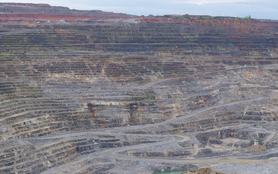
Godfried Ofori, of the Concerned Citizens Association of Prestea, stands in front of a mine pit and waste dump area near Golden Star Resources mine in southwest Ghana. Photo: Jane Hahn / Oxfam America

What do we mean by social conflict?

More than 500 protesters took to the streets in Prestea in the western region of Ghana in 2005 to demonstrate against Bogoso Gold Mines (a subsidiary of Golden Star Resources), resulting in injuries to seven protesters. Tensions grew as a result of alleged water pollution and damage to homes from mining explosives and eventually led to project suspension.

Social conflicts and controversies surrounding large-scale oil and mining projects often stem from concerns around potential or actual environmental impacts and land acquisition disputes, and sometimes erupt into violence. Past Oxfam blogs have highlighted examples of this in countries where we work like Peru and Ghana.

Oxfam America’s recommendations for companies and government agencies charged with managing the oil and mining industries primarily aim to increase community participation in decision making around projects, and ultimately at preventing social conflicts. National human rights institutions (NHRIs) represented one interesting policy avenue that we had yet to address.

What do we mean by a national human rights institution?

State-sponsored NHRIs–tasked with protecting and promoting human rights– have grown in popularity in recent decades. To date, the UN International Coordinating Committee on NHRIs has accredited 99 of these institutions globally. The closest equivalent agency in the US would likely be the US Commission on Civil Rights, which is tasked with informing national civil rights policy and studying alleged deprivations of voting rights and discrimination.

While NHRIs take on a diversity of forms and functions, they will often provide human rights education, hear human rights complaints, mediate complaint resolution, and/or enforce remedies. Some of these institutions are charged with a narrow mandate to protect the human rights of particular groups (e.g., minorities or persons with disabilities) or to protect particular rights (e.g., anti-discrimination), while others have a broad mandate to protect and promote all human rights for all persons. Some NHRIs, like Ghana’s, have a formal mandate to investigate complaints about human rights abuses by private entities, including businesses, while others do not.

In the context of the extractive industries, NHRIs may be called on to address a wide range of human rights abuses. These could include, for example, impacts on the right to property such as by forced displacement or damage to crops or houses, or violence directed at local communities by police or security forces.

How can NHRIs better address social conflicts related to extractive industries?

The new Oxfam research launched in Washington, DC today presents a framework for evaluating NHRIs’ impact on promoting and protecting human rights in the context of the extractive industries, and how this framework can be applied in individual country contexts. The research identifies five categories of determinants for NHRI effectiveness: independence, power, promotion, empowerment, and remediation. These were based on a growing body of literature on effectiveness factors for NHRIs, and then prioritized based on the unique features of oil and mining projects, e.g. their long-term, large-scale nature and their tendency to impact remote and marginalized communities.

An open pit mine in the town of Prestea, Ghana, where Oxfam parter organization, WACAM, has been supporting the Concerned Citizens Association of Prestea in its efforts to negotiate with a mining company around issues related to air and water pollution, and the proposed expansion of mining operations. Photo: Jeff Deutsch / Oxfam America

The research includes a case study on Ghana’s NHRI, the Commission on Human Rights and Administrative Justice (CHRAJ). Based on a literature review and interviews with civil society leaders, mining industry representatives, and CHRAJ officials in Ghana, researchers applied their new framework with CHRAJ to come up with recommendations to strengthen its effectiveness in the mining and emerging oil sectors. Results indicate that CHRAJ should develop a systematic and targeted strategy for communicating with communities affected by oil, gas, and mining operations. Information provided by CHRAJ should ideally provide community members with a clear understanding of their rights, how extractive projects may violate them, and how to seek remedy if these rights are violated.


Why should NHRIs engage more with communities?

While the new framework for evaluating NHRI effectiveness will generate different results based on differing country contexts, the finding in the Ghanaian context that community engagement should be a key priority for NHRIs will likely resonate in many of the countries that experience human rights abuses and conflict around mining and oil projects. Often the complex impacts of extractive projects are difficult for community members to anticipate or respond to, particularly when they involve politically-charged issues such as resettlement or technical issues such as water pollution from mine runoff. When NHRIs engage with more informed and active communities, they will find their education and enforcement mandates much easier to fulfill.

If more NHRIs begin to effectively and proactively engage with project-affected communities in preventing human rights abuses and conflict, not only local communities and host governments will benefit. The global community will also benefit from the subsequent increase in stability around the extraction of the oil and mineral resources on which we all rely.

US giving away gold

December 13th, 2012 | by

It sounds like a late-night TV infomercial, but it’s true. In the midst of a fiscal crisis, the US government receives no royalty payments for gold extracted from federal lands. Yesterday, the US Government Accountability Office (GAO) released a report on mineral extraction and revenues from land administered by the Department of the Interior. The report, requested by Senator Tom Udall and Rep. Raul Grijalva, found that not only does the government not collect any royalty for “hardrock minerals” such as gold, silver, copper, and uranium, it does not even know how much of such minerals are being produced! “We found that federal agencies generally do not collect data from hardrock mine operators on the amount and value of hardrock minerals extracted from federal lands because there is no federal royalty that would necessitate doing so,” the report said.

This bizarre state of affairs is a result of the General Mining Act of 1872 which, amazingly, still governs hardrock mining and allows operators to mine without paying any royalty. No benefits and significant impacts on the environment and Native and other communities—sounds like a great deal. In contrast, oil and gas royalties from federal lands provided $10.1 billion to the Treasury each year in 2010 and 2011.

The government has been “leaving a huge pot of money on the table”, says Rep. Grijalva. “There’s no reason to keep these extraction and royalty laws out of date… Keeping the public and Congress in the dark any longer about what’s going on with federal property doesn’t serve any public purpose, and it should end.” said Grijalva, a member of the House Committee on Natural Resources.

Even when royalties are collected for oil and gas, the rates are quite low. Many offshore oil lease royalty rates are as low as 12.5 percent. But it gets worse. The “effective royalty” rate found by the GAO study—the amount the government actually collected—was in some cases significantly lower than the rate specified in the lease. (Though it was not a focus of the report, it is worth noting that for the years studied in this report, FY10 and FY11, surprisingly little revenue from these offshore leases, unlike oil and gas activities on public lands, comes back to the coastal communities and states bearing the brunt of the risk from these activities, particularly across the Gulf of Mexico. Much has been written in recent weeks about incoming Senators Ron Wyden, Lisa Murkowski, and Mary Landrieu’s interests in addressing this disparity in revenue sharing in the 113th Congress.)

It should not take Members of Congress asking the GAO for information for citizens to know how much is being generated by our nation’s oil, gas and minerals. One part of the fix is implementation of the Section 1504 (the so-called “Cadin-Lugar” provision) of Dodd-Frank. The Securities and Exchange Commission has issued final rules for Section 1504 that require all oil, gas and mining companies reporting to the SEC to disclose royalties and other payments on a project-by-project basis—both in the US and abroad.  The Interior Department has expressed support for this provision. Oxfam and the Publish What You Pay US coalition has been working for the past two years on getting this provision implemented and Oxfam is now part of a legal battle pitting the US oil industry against the SEC.

US implementation of the international voluntary Extractive Industries Transparency Initiative by the Department of the Interior may also help. But as the GAO notes it is unclear whether production of hardrock minerals will be required—as in some other countries—and full reporting and implementation may be four years down the road.

Ultimately, it is up to Congress to reform the outdated 1872 mining law. Rep. Grijalva has cosponsored a bill, the Fair Payment for Fair Payment for Energy and Mineral Production on Public Lands Act, which would set a 12.5 percent royalty rate on hardrock minerals and says “he looks forward to supporting and strengthening an updated version in the upcoming Congress.”

New research highlights more human rights commitments from oil and mining companies

September 26th, 2012 | by

Indigenous people hold their own consultation in Guatemala. Photo by Oxfam.


This blog was written by Emily Greenspan, Oxfam America extractive industries policy and advocacy advisor. 

Watch a panel discussion on Oxfam’s Community Consent Index Report featuring the authors here.

This year, Oxfam has written about protests and conflicts near oil and mining projects operated by companies both large (like US-based Newmont and Switzerland-based Xstrata) and small (like the Ghanaian company Solar Mining). New examples are cropping up frequently. Just this month, indigenous communities stopped production of nine Maple Gas oil wells in the northern Peruvian Amazon over alleged pollution. The leader of the affected Canaan de Cachiyacu communities stated that they were not consulted prior to oil development. Also this month in Peru, the Canadian oil company Talisman Energy—which has drawn criticism from some environmental NGOs for failing to secure indigenous peoples’ consent—withdrew from its concession in the northern Amazon.

Given this context, it may not be surprising that some oil and mining companies are beginning—at least on paper—to recognize that they benefit from strong human rights and community engagement policies. My colleague Marianne Voss and I recently completed research that surveyed the human rights policies of 28 oil, gas, and mining companies with a particular focus on the issue of community consent—looking closely at whether company policies required local community approval prior to implementing projects. This research followed and expanded on a similar report that Oxfam America produced in 2009.

The research, titled the Community Consent Index, found that five companies with a total market cap of $180.58 billion (Inmet, Newmont, Rio Tinto, Talisman, and Xstrata) have made explicit public commitments to attaining Free Prior Informed Consent (FPIC), a number which has doubled since the 2009 report. Another eight companies (including Anglo American, BP, Repsol, and others) have made somewhat qualified or indirect commitments to FPIC. Overall, two-thirds of the companies reviewed have incorporated in their policies concepts related to community consent, community support, or social license. Increasingly companies are recognizing and embracing the business case for community consent.

The research also looked more broadly at oil and mining company adoption of public human rights commitments and policies, and findings suggest that it is now standard practice for companies to commit to protecting human rights. All but two of the 28 companies reviewed have made explicit commitments to human rights, and all but five have made explicit commitments to indigenous peoples’ rights. Just over half of the companies surveyed have reported developing a human rights policy, with eleven companies making their human rights policy publicly available and six of those companies also publishing implementation guidelines.

As we celebrate the fifth anniversary of the United Nations Declaration on the Rights of Indigenous Peoples this month, it is encouraging to see increasing company commitments to FPIC – a right for indigenous peoples that is enshrined in the declaration. However, there’s much more work to be done, not only in terms of strengthening company policies, but also towards the goal of improving implementation of consultations with communities. (Our report doesn’t attempt to measure implementation against policy). We hope that communities impacted by mining or oil projects will use the report to monitor implementation and report cases where policies have not been followed.

Consultations should aim to achieve community consent and empower communities to make decisions about the use of their lands and natural resources. In a separate piece of research, Oxfam has looked at three consultation experiences in Peru and Bolivia that resulted in agreements between indigenous peoples and company or government representatives, and has identified some interesting lessons learned. Of course, effective implementation of consultations remains a critical challenge.

Though the trends we are seeing on paper are positive, there remains much to be done both on the policy and on the implementation front. Let’s hope that with the next iteration of Oxfam’s Community Consent Index in two years we see many more oil and mining company commitments to community consent, as well as more public human rights policies and implementing guidelines.

After a long haul, SEC finally acts for oil, mining transparency

September 11th, 2012 | by

It took far longer than I—or any of us at Oxfam—expected, but the US Securities and Exchange Commission (SEC) has finally issued binding regulations to implement the oil, gas, and mining disclosure provisions contained in the 2010 landmark Dodd-Frank Wall Street Reform Act. Starting in 2014, an estimated 1,100 companies will have to start disclosing the payments they make to governments on a country-by-country and project-by-project basis. This includes American companies such as ExxonMobil and Chevron, foreign companies, such as BP and Shell, and some companies from emerging markets such as China, India, Brazil, and Russia.

On August 22, the SEC approved regulations to enforce Section 1504 (“Cardin-Lugar”) passed over two years ago. (Since the SEC was more than a year past the Congressionally mandated deadline, Oxfam America used public pressure tactics—including stunts in front of the SEC and Chevron—as well as litigation to try to compel the SEC to act.)

Oxfam activists outside Chevron's headquarters in Houston. Photo by Scott Dalton.

While many were worried that the SEC would give in to the demands of the oil industry to issue watered-down regulations, and Oxfam America is still completing a legal review of the regulations, the agency appears largely to have stuck to the statutory language and Congressional intent. For example, the SEC did not grant any exemptions to the disclosure requirements for covered companies. Some oil companies had said that they should be allowed to withhold disclosures in certain countries that legally prohibit disclosing government payments, but Oxfam America and its allies in the Publish What You Pay US coalition made it clear to the SEC that such prohibitions have not been shown to exist.

The requirements as enacted have been hailed in the developed and developing world. Such ideologically diverse publications as the Financial Times and The Nation have both praised the SEC move. The FT said in an editorial (“Sunshine Rules”) that the new SEC regulation “puts legal force behind a demand long pushed by civil society organisations: that extractive companies disclose the payments they make to host governments… the transparency rule will make a real difference.”

Hannah Owusu-Koranteng, one of the founders of WACAM, a mining activist group and Oxfam partner. Jeff Deutsch/Oxfam America.

On the ground, activists are eagerly awaiting the disclosures. In Ghana, Hannah Owusu-Koranteng, an Oxfam partner from WACAM, a mining activist group, said the project-level disclosures required will “provide communities and local officials in Ghana with detailed information on the revenue flowing to government from gold extracted from their lands.” (Just before the SEC vote, I was in Ghana’s Western Region – a part of the country rich in gold and oil – looking at our district assembly budget monitoring work. SEC project-level disclosures will certainly help district officials and citizens “follow the money”.)

In Cambodia, a country rich in natural resources but where more than 50 percent of the population lives on less than two dollars a day, very little public information about oil and mining revenue is available. SEC disclosures by Chevron and others will put information into the hands of activists who have been failed by international voluntary measures such as the Extractive Industries Transparency Initiative (EITI). The SEC move has made a big splash, with coverage in the Phnom Penh Post and Khmer-language media. Oxfam partner Cambodians for Resource Revenue Transparency hailed the regulation as a landmark for the transparency movement.

Reading through the SEC’s 231-page explanation of the rules (and I’ve never been more excited to read a government regulation!), I was inspired by the involvement and impact of civil society groups from around the world who shared their views—and evidence—directly with the SEC drafters in Washington through a transparent regulatory process. Input from groups in Ghana, Peru, Ecuador, Equatorial Guinea, Angola, Nigeria, Burma and elsewhere shared a common theme—this information will be vitally important in our fight for transparency.

Enactment of the regulations is now having a global ripple effect. In Europe, the European Parliament has scheduled an important committee vote on a proposal to possibly match—or go beyond—the US requirements and European Members of Parliament are pointing to the final SEC rule to push for strong requirements there. (Companies that are “cross-listed”—on stock markets in the US and Europe—already have to comply with the strong SEC rules, so Oxfam believes they should drop their efforts to slow or weaken progress in Europe.) Also, last week Publish What You Pay Canada and Revenue Watch Institute announced an agreement with the two largest mining industry associations in Canada to develop mandatory reporting requirements for Canadian stock exchanges.

Real social progress takes time (and monkeys). It’s been a 10 year fight to get this far. Next week the Publish What You Pay coalition celebrates its 10th anniversary with a well-timed global conference in Amsterdam bringing together more than 250 activists from 50+ resource-rich countries. The next 10 years must be focused on finishing the job and putting this information to work to ensure that oil and mining billions are invested in people, not lining pockets!


Peru’s mining conflicts explode again: Protests and violence in Espinar

June 6th, 2012 | by

This blog post is written by Keith Slack, extractive industries program manager.

Peru’s long-simmering mining-related social conflicts blew up again last week in the southern province of Espinar, where police shot and killed two local community members who were protesting for greater benefits from giant Swiss mining company Xstrata. As I’ve written previously, Peru has been beset by such conflicts for more than 10 years, as high global prices drive more and more mining in the country—considered to have one of the world’s most favorable geological endowments. Late last year, the Minas Conga project in the northern province of Cajamarca was also hit by protests as community members blocked highways to prevent construction of the project by US-based Newmont. The $5 billion project is Peru’s largest foreign investment.

Villager from Espinar, Peru views Tintaya mine’s tailings dam. Diego Nebel/Oxfam America.

The protests in Espinar and Cajamarca, occurring at opposite ends of the country, have been cited by some analysts in the country as sort of twin poles of a broad anti-mining conspiracy. This is a fairly ridiculous accusation given, among other things, that the protests in Espinar weren’t “anti-mining” but actually mainly about demanding greater benefits from mining. (How could they be opposed to mining if they want more money to come from it?) There’s also no evidence that people in Cajamarca have any particular ideological opposition to mining. They just don’t happen to want four lakes destroyed that they use to support their agricultural livelihoods. Even Marco Arana, a Catholic priest from Cajamarca who is seen by some as the Svengali of the “anti-mining” movement, has said clearly he’s not opposed to mining in general, but is opposed to mining activities that destroy watersheds and contaminate groundwater.

President Ollanta Humala was elected a year ago with a fair amount of hope that he could provide a solution to these conflicts, but much remains the same. The killing and violence continue, as in Espinar. The Ministry of Energy and Mines retains ultimate authority for approving mining companies’ environmental impact assessments (EIAs)—a direct conflict of interest that undermines confidence in the independence of governmental oversight of the mining industry. And the mining industry continues to push forward at an alarming pace. In research that will be published later this year by Oxfam America, we will show graphically how large swathes of the country have been conceded to mining and oil interests. This is of particular concern in agriculturally productive areas, where mining concessions now cover more than 30% of these lands.

Humala has spoken of a need for a “new vision” for mining in the country. To this point, however, that vision hasn’t included a lot of details. There are a few basic starting points that we would propose for his consideration. One is zoning, or “ordenamiento territorial” in Spanish—basically identifying those areas in the country that are socially and environmentally viable for mining and those that aren’t. Our partner Cooperaccion has done extensive work on this issue.

Another key point is security sector reform, particularly relating to security forces that protect mine sites. This is a sector that is rife with abuse, as we saw in Espinar. In Peru, mining companies employ private security contractors and local police to protect their operations. In fact, police often use mine camps as bases for operations, including storing large caches of weapons. Companies are therefore ultimately accountable for actions that these forces take. A few years ago, in the process of resolving a complaint we filed against Newmont Mining for human rights abuses at its giant Yanacocha Mine in Cajamarca, we learned that police forces can in effect instantaneously “deputize” private security contractors in the midst of a police operation. This situation is ripe for abuse; one in which accountability becomes ambiguous. These ambiguities need to be resolved and mining companies and police need to reaffirm their commitments to human rights standards including the Voluntary Principles on Security and Human Rights, a global standard for human rights in the extractive industries.

Additionally, the Humala government needs to end criminalization of mining protests. Peruvians, like all people, have a basic human right to peacefully express their views. In no situation should peaceful protest be met with violence or human rights abuse as happened in 2005 in the northern department of Piura in which 28 community members were detained and tortured (yes, tortured) by private security forces and police for opposing the Chinese-owned Rio Blanco project. (Just this week false charges brought against these protestors were dropped, thanks to the dogged efforts of Oxfam America partner Fedepaz.) In Espinar, the national government has declared a state of emergency, suspended civil liberties and detained mayor Oscar Mollohuanca, allegedly for inciting the protests.

Finally, strengthening Peru’s environmental management capacity is critical to increasing confidence among local communities in the government’s ability to protect their lives and livelihoods. It’s simply not the case that mining-related environmental problems are a “thing of the past,” as some in Peru argue. All mines, including those run by big modern companies, pollute the environment in some way. Closely monitoring these impacts and holding companies accountable is critical. Moving final authority for approving mining EIAs out of the Ministry of Energy and Mines and into a strengthened Ministry of the Environment would be an important step in this direction.

Ultimately, if Peru is to find a way out of this cycle of conflict (which at present shows no signs of abating), the government should take steps like those above and also articulate a vision for how mining – and the revenues it generates—can link more harmoniously and beneficially to traditional agricultural livelihoods that predominate in the highland areas where most mining takes place in the country. Finding a way to channel the substantial revenues coming from mining to sustainably support these livelihoods and protect the water and land on which they depend seems to me to be critical to finding a way out of the current cycle of conflict. Short of that, the protests—and violence—will surely continue.

Oil transparency now!

March 8th, 2012 | by
Publish What you Pay US Director Isabel Munilla and Oxfam America staff deliver petitions to the American Petroleum Institute. Photo by Jessica Forres/Oxfam America.

Publish What you Pay US Director Isabel Munilla and Oxfam America staff deliver petitions to the American Petroleum Institute. Photo by Jessica Forres/Oxfam America.

Almost a month ago, Oxfam America and allies in the Publish What You Pay US coalition took the gloves off in our campaign to stop Big Oil from succeeding in a behind-the-scenes push to gut the landmark oil and mining payment transparency provisions of the Dodd-Frank Wall Street Reform Act.

Who knows how this fight will ultimately end, but we are making real progress. Since the start of this campaign spike, we’ve had dozens of media hits and turned this from a secret struggle at the SEC into a very public fight about oil company secrecy. And we’ve had fun along the way—Our fabulous “oil companies in bed with the SEC stunt” was quickly followed frisky group of “see no evil” monkeys in an oil barrel outside the Chevron tower in Houston—a stunt that was covered in the Houston Chronicle and the San Francisco Chronicle.

We’ve had high-profile figures weigh in as well, from Bill Gates to Secretary of State Hillary Clinton. In her remarks at a Senate hearing last week—watch a video of her remarks here—Clinton said the SEC should “go as far as possible” in implementing the final rule. “We know that there are challenges in doing this. I hope the regulations expected from the SEC reflect the clear intent of the law, namely to require all relevant companies operating in this sector to disclose the payments they make to foreign governments. I think everybody is benefited from the disinfectant of sunshine and the spotlight to hold institutions accountable.”

Fourteen senior Members of Congress led by Rep. Frank—including eight appropriators who will certainly have the ear of SEC Chairman Schapiro as she goes to Capitol Hill to fight for her agency’s budget—wrote to the SEC on Feb. 15 to say that they are aware of efforts by industry to press the SEC to release a “watered down rule that does not reflect the statutory language” and urged Chairman Schapiro “to resist this pressure and promptly release a strong and effective final rule.” Schapiro told appropriators this week that the rule will be finished “shortly”, but she’s made promises before and the SEC is almost a year beyond the Congressional deadline to implement this provision.

Oxfam’s supporters have also really come through—more than 24,000 have signed a petition to the oil industry and we delivered those petitions today to the American Petroleum Institute, the industry’s lobbying arm. (Our ally Revenue Watch Institute also pitched in to add some signatures to the pile.) The ONE campaign has delivered more than 100,000 signatures to the SEC calling on them to quickly issue a strong rule.

Finally, we are getting elite business media opinion on our side. In a great editorial, the Financial Times said that “oil companies are wrong to resist publication of payments” and that lobbying efforts aimed at overturning progress in the US and Europe “should not be allowed to succeed”. The Economist ran an article at the end of February saying that if oil companies go to court to block the SEC final rule it could “become a public-relations disaster”. Indeed.

If oil companies thought they could hide behind the Extractive Industries Transparency Initiative (EITI), they may want to think again. Oil companies have long held that EITI—which only requires company disclosure when a country faithfully implements the initiative—is the only way to go and that mandatory regulations would destroy EITI. Clare Short, board chair of EITI, has a different view—mandatory regulations and EITI are perfectly complementary.

It’s clear that both the oil companies and the SEC are feeling the heat. We need to keep piling on the pressure so we can make it over the finish line with a strong regulation.

Big oil uses fiction, not fact, to oppose new transparency rules

February 17th, 2012 | by

This guest blog post by Jonathan Kaufman is cross posted with permission from EarthRights International.

Are wild claims “facts”? Oil companies would like you to believe so. Spend some time perusing the avalanche of submissions that oil and gas companies have sent into the Securities and Exchange Commission (SEC) trying to water down forthcoming rules requiring them to publish their payments to the governments where they operate, and you’ll notice that they have one thing in common: a nearly complete lack of facts to back up their wild claims.

EarthRights International (ERI) advocates for strong rules because our community partners in Burma and elsewhere want to use payment information to hold their governments accountable for the wealth received from resource extraction. But the companies complain that if they have to disclose their payments as Congress has mandated, they’ll lose contracts to less transparent competitors and could be forced to violate foreign restrictions on disclosure. Their lawyers and lobbyists have done their job well – nothing keeps regulators off your back like an appeal to their fear of losing out to the Chinese or crippling American enterprise in uncertain economic times. Yet their submissions are curiously devoid of evidence; instead of providing facts, the companies pose hypotheticals, speak in generalities, and float widely varying estimates of compliance costs with no explanation.

Meticulous research by Publish What You Pay coalition (PWYP) members has shown that these scare tactics are just smoke and mirrors. When you place the companies’ claims next to the actual facts, it’s clear that what Big Oil really fears is public scrutiny of its questionable dealings, rather than competitive injury to its operations. The SEC must show that it’s not “in bed” with Exxon and Chevron and their friends and issue rules that comply with the law.

ERI recently submitted a letter to the SEC comparing unsupported industry allegations with the facts that PWYP has put in the record. A sample of the most glaring of these comparisons speaks for itself on how misleading and potentially damaging the companies’ submissions can be:

Industry claim #1: Unless the SEC grants an exemption to avoid disclosing payments made to countries that prohibit disclosures by law, the new rules will force companies to violate those laws and threaten billions of dollars in projects in the relevant countries.

Facts: Of just four countries identified by industry as having disclosure prohibition laws, three clearly do not prohibit disclosure, and there is no evidence of a legal prohibition in the fourth. In fact, at least two companies already disclose many of their payments in at least two of these countries, and one admits in the record that it knows of no prohibition.

Why it matters: An exemption for foreign laws would give secretive states – think China, Iran, and Burma – an incentive to pass laws prohibiting disclosure, giving them a veto over the U.S. Congress and cutting off information from the countries where it’s most vital.

Industry claim #2: It would cost big money to make the changes to corporate accounting systems that would be necessary to capture and disclose all payments at the project level.

Facts: Two industry associations actually admit that no company has done an in-depth cost estimate. Companies’ “guesstimates” range from hundreds of millions of dollars to “de minimis” (negligible) amounts, and at least one mining company says it already tracks most of the information and discloses it on a voluntary basis. Moreover, companies need to record government payments anyway, in order to comply with U.S. anti-corruption laws.

The bottom line: Companies are using these inflated estimates in order to erode the clear standards Congress wrote into the law. If they can convince the SEC that it’s too expensive to implement the rules according to the plain language of the law, they hope the agency will re-define key terms in order reduce the amount of information disclosed.

Industry claim #3: Producers covered by the new rules will lose out to less transparent companies, such as national oil companies from China, Russia, and Iran, because some host governments will prefer to deal with companies that don’t publish their payments.

Facts: Companies covered by the new rules have continued to beat out non-covered Asian oil producers for contracts in some of the world’s most opaque countries, even after the passage of the disclosure law. Transparency requirements haven’t deterred companies from listing either in the U.S. or on the Hong Kong Stock Exchange (which also requires payment disclosures). And in the section of their annual reports where they have to report significant prospective financial risks, no company has seen fit to warn its investors that the disclosure law poses any danger to its bottom line.

What it’s really about: This is a thinly-veiled threat to sue the SEC over a particular type of cost-benefit analysis that the companies claim the agency is required to do, and to seek to have the rules vacated in court if industry doesn’t like them.

Of course, these three examples only scratch the surface of the companies’ unfounded allegations. As ERI shows in its submission, companies also use strategic misdirection to mislead the Commission on technical definitional issues (e.g., what is a “project”?) and on the legal implications of publishing false information, among other things.

For many of us who are watching this largely behind-the-scenes drama unfold, it’s obvious that industry is hoping to intimidate the SEC into issuing weak rules, and if the companies don’t get their way, they plan to sue the agency. (In fact, they more or less announced this intention in a recent submission.) If the SEC ends up in court, though, it will have to defend its decisions based on the words Congress wrote and the facts in the record. Fortunately for the supporters of payment transparency, the statutory language and the facts are completely in accord in this case, and they point to robust, project-level reporting of payments, with no exemptions.

The fight is on!

February 14th, 2012 | by

In the first Star Wars movie, Luke Skywalker and friends somehow blew up the Death Star. That’s a bit how we felt in 2010 when after years of fighting we got a new global financial transparency requirement into the Dodd-Frank Wall Street Reform Act. The provision requires oil, gas, and mining companies to disclose tax and other payments in every country of operation. As I’ve been writing about in the last two weeks, we now feel like we are in The Empire Strikes Back. The oil industry has threatened to sue the SEC if they don’t get a regulation they like and are using lobbyists and lawyers to try to roll-back our victory.

SEC ad campaign photo

Now it’s time for Revenge of the Jedi and the gloves are off. Oxfam and our allies in the Publish What You Pay coalition are mounting a big campaign to tell oil companies to stop fighting transparency—join us to take action. We have a six-figure ad campaign running the next two weeks, including a full-page ad in the Wall Street Journal, and online ads in the Washington Post, The Hill, Politico, and the Huffington Post. (The Wall Street Journal ad is endorsed by Global Witness, Revenue Watch Institute, Global Financial Integrity, EG Justice, and the Task Force on Financial Integrity and Economic Development.)

In addition to mounting an e-action campaign targeting Chevron, Exxon and ConocoPhillips, Oxfam is reaching out to our university campus-based CHANGE student activists for a petition drive to SEC Commissioners telling them to issue a strong final regulation. The ONE campaign is also pressuring the SEC with a petition that has over 84,000 signatures so far.

Last week Oxfam activists portrayed Chevron, Exxon, and the SEC in bed together outside SEC headquarters in Washington, which generated good coverage including the morning commute on NPR. This week, the “hear no evil, see no evil” monkeys will be outside the Chevron tower in Houston, telling the company and its employees the time for silence is over.

Congress is ramping up the pressure on the SEC to issue a strong final rule and to follow the law—five prominent Senators wrote on Jan. 31, and we are expecting more Congressional pressure this week.

The battle is also being fought on a number of fronts. Over in Europe, activists staged a stunt a government building in London and the ONE campaign has a big petition drive to make sure European regulators stand up to oil company lobbying there. Elsewhere, allies in resource-rich countries such as Ghana, Equatorial Guinea, Senegal, Cambodia, and Ecuador are writing to the SEC to make sure they know how important this information is to hold their own governments accountable for the spending of oil and mining wealth.

Oil companies have a lot on their plate and this lawsuit has the makings of a classic PR nightmare. (Imagine the headlines—“Oil companies sue to keep tax payments secret”.) Let’s win again and bring this saga to an end.

Oxfam SEC oil transparency stunt.  Photo by Oxfam America.

Oxfam SEC oil transparency stunt. Photo by Oxfam America.

The transparent hypocrisy of big oil

February 9th, 2012 | by

The oil and gas industry loves to trumpet their support of international transparency initiatives and their tax contributions to the US government, but when a new law requires them to tell the public exactly how much gets paid to whom around the world, they bring out the lobbyists and lawyers.

Browse through the corporate social responsibility reports of the top oil and gas companies, and you’ll see them singing from the same transparency hymnbook. Chevron says it “believes that the disclosure of revenues received by governments and payments made by extractive industries to governments could lead to improved governance in resource-rich countries.”

Many oil and gas companies are also “supporters” of the global Extractive Industries Transparency Initiative (EITI). (Companies can become a “supporter” simply by declaring “their support publicly”.) Unless a country decides to implement EITI, though, they are obliged to disclose nothing. For a company such as Chevron, this means disclosing tax and other payments in Nigeria (perhaps years after the fact), but nothing in next-door Equatorial Guinea, a classic petro-dictatorship. For the citizens of Equatorial Guinea—mala suerte (tough luck)!

In July 2010, the Dodd-Frank Wall Street Reform Act was signed into law. Dodd-Frank contains an important provision (“Section 1504″) that requires each oil, gas, and mining company to disclose their tax, royalty and other payments to governments in every country of operation. (Oxfam and our allies in the Publish What You Pay campaign fought hard for the inclusion of this provision—alongside our support for EITI.)

Many of the same companies praising transparency have been actively lobbying since the law passed to gut implementation by the Securities and Exchange Commission (SEC). The hypocrisy is out there in the open if you know where to look. Senate lobbying disclosure forms show that Chevron, Exxon, Shell, Conoco Phillips, Marathon, Occidental, the American Petroleum Institute (API), and others have been very active in Washington on this provision, targeting not only the SEC, but the House of Representatives, Senate, Department of State, Department of the Interior, and the National Security Council.

As I wrote last week, API (revenues of more than $198 million in 2009) has now threatened to sue the SEC unless the agency withdraws its proposed rule and starts from scratch to meet big oil’s secrecy wishes rather than the law and Congressional mandate. (Five API member companies are also on the EITI board, Exxon, Chevron, Shell, BP, and Statoil.)

Wiston House where the EITI board meeting will be held next week. Wikimedia Commons.

Wiston House where the EITI board meeting will be held next week. Wikimedia Commons.

No one knows how much the oil and gas industry is spending specifically to undo the Dodd-Frank provision, but the oil and gas industry is one of the biggest lobbyists in the US, spending more than $145 million on lobbying activities in 2011. ConocoPhillips, Shell, ExxonMobil, Chevron and BP were the top five oil and gas spenders on lobbying in 2011, with ConocoPhillips spending a staggering $20.5 million. API spent more than $7 million in lobbying in 2011 and is spending a “significant amount” on its faux “grassroots” advertising campaign called “Vote 4 Energy”. These are the same companies who complain that the cost to disclose information they already collect is too onerous.

The yawning gap between the transparency rhetoric of companies and the reality of their actions has never been more apparent than it is now. The SEC may shortly issue a final rule to implement the Dodd-Frank provision, while on February 14th the oil industry’s designated transparency groupies, governments, and civil society groups will convene in the UK for the latest EITI board meeting. While the EITI board members enjoy the lovely and historic “Downton Abbey”-esque country manor setting of their board meeting, the industry’s lawyers and lobbyists will be working hard in Washington to gut a new global corporate transparency standard.

It’s time to blow the whistle on the industry’s transparent hypocrisy. For the more than 1.5 billion people living on less than $2 a day in resource-rich countries, there’s no time left to wait.

Village residents fetch water from a communal pump in Faloumbou, Senegal Tuesday. Rebecca Blackwell/Oxfam America.

Village residents fetch water from a communal pump in Faloumbou, Senegal Tuesday. Rebecca Blackwell/Oxfam America.

RSS Feed