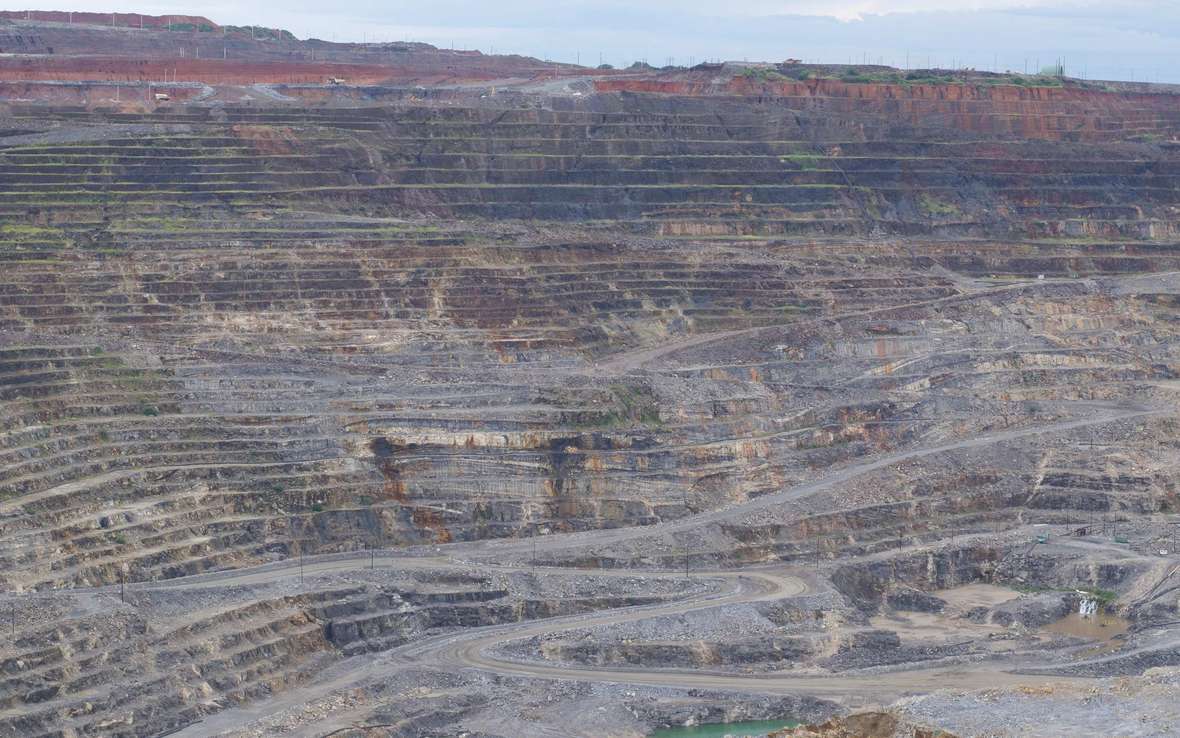
The US government is increasing support for mining through new country partnerships and proposed legislation. Without requiring strong standards to reduce environmental and social risks, these efforts will fail to promote the reliable supply chains they seek to secure.
The United States, Japan, Australia, and India have announced the “Quad Critical Minerals Initiative” to secure critical mineral supply chains and counter China’s domination of the sector. The partners seek to mobilize up to $20 billion to support mining projects through export credit agencies, subsidies, offtake arrangements, and other approaches. At the same time, bipartisan draft legislation aiming to bolster mineral supply chains is advancing through Congress.
These actions follow a flurry of activity by the US government related to critical minerals, including a Critical Minerals Ministerial which drew more than 50 countries to Washington, DC in February and resulted in the US signing bilaterial mineral agreements with 11 countries. Unfortunately, the administration has focused very little attention on the need to condition US support on strong environmental and social standards despite evidence that these standards represent a cornerstone for long-term, reliable and sustainable mineral supply chains.
Here are three reasons Congress should condition US government funding on strong environmental and social standards:
Strong standards give companies a competitive advantage.
You may expect to hear Oxfam say that standards play a vital role in reducing human rights and environmental risk and ensuring reliable mineral supply chains, but mining companies also recognize these benefits. At a briefing on Capitol Hill earlier this year, Nat Adams, Global Government Relations Director for Newmont Corporation, explained that social and environmental standards give Newmont “a competitive advantage”, noting that standards serve as a tool to reduce risk and that “higher quality performance means lower costs of capital.” In particular, he emphasized the importance of strong company engagement with local communities, noting that “trust is a critical determinant of project viability and project proponents ignore that at their own peril.”
Newmont is not an isolated voice here. Mining companies consistently recognize the importance of a social license to operate (or the acceptance and permission from communities and society) for their business. EY interviewed 500 senior mining and metals leaders to identify the Top 10 business risks and opportunities for mining in metals in 2026. License to operate appeared in the top 5 issues on the list, as it has consistently for the last eight years. Many mining companies have experienced social conflict and litigation firsthand, leading to project delays or shutdowns (see Oxfam’s policy brief on Critical Mineral Security and the Social License to Operate for examples). According to Rohitesh Dhawan, CEO of the International Council on Mining and Metals (ICMM), “A legal license tells you that you can mine; a social license tells you if you should.”
The cost of implementing standards pales compared to the costs of social conflict.
Failure to ensure the social license to operate can come at a huge cost. Research by Harvard University, Shift, and the University of Queensland found that a mining project stands to lose approximately US$20 million per week in lost productivity as a result of delayed production from social conflict. New research from Spektrum analyzed 50 critical minerals projects in 28 countries representing approximately US $370 billion in combined value. The analysis found that almost two-thirds of that value is exposed to legitimacy risks like social conflict and legal challenges that no one is pricing.
At the same time, new research from the Rocky Mountain Institute found that average loss exposure can be up to approximately 5 times responsible mining costs. The research estimated responsible mining costs at only about .4% with respect to a mining project’s capital expenditure. The study looked at the costs of participating in the Initiative for Responsible Mining Assurance (IRMA) – a rigorous voluntary mining standard which requires third party verification – and found that the costs of IRMA implementation represented no more than two-fifths of overall costs associated with implementing mining best practices.
Weak standards do not effectively mitigate risk, so choosing the right standard matters.
Not all standards are equal. The rising demand for critical minerals has spurred the development of a proliferation of mining standards. Last year the UN Environment Programme (UNEP) and the Intergovernmental Forum on Mining, Minerals, Metals and Sustainable Development (IGF) documented over 100 standards and initiative related to mining and metals. With so many standards available, and some of these very industry-driven like the Consolidated Mining Standard Initiative, the risk of greenwashing increases.
Despite this proliferation, good standards exist and there is no need to reinvent the wheel. Oxfam supports IRMA because it provides a true independent assessment against a comprehensive and rigorous standard, governed by a multi-stakeholder board with equal stakeholder leaderships. In a 2024 assessment of third-party mining assurance schemes by the Lead the Charge coalition, IRMA stood out as the strongest by a considerable margin. Criteria for assessment included factors like governance, participation of rights holders, requirements for corrective actions, and grievance mechanisms. Strong mining standards must align with international law and best practice regarding the protection of the environment and human rights, including Indigenous Peoples’ right to free, prior, and informed consent.
While Oxfam sees IRMA as the gold standard, we also recognize the importance of standards like the International Finance Corporation’s Performance Standards on Environmental and Social Sustainability, which have been widely adopted by the private sector, as well as more than 150 banks, credit agencies and development finance institutions, including the US International Development Finance Corporation (DFC) and the Export-Import Bank of the United States. Implementation of the IFC’s Performance Standards should be a minimum requirement for any US investment in mining.
Recommendation for Congress
It was encouraging to see standards mentioned in the DOMINANCE Act, bipartisan legislation seeking to strengthen mineral supply chains which recently passed the House Foreign Affairs Committee. However, given the wide spectrum of mining standards circulating presently, the US government should be more explicit about the specific standards that should be applied.
As the Senate considers companion legislation to the DOMINANCE Act like the Critical Minerals Security Partnership Act of 2025 and the Energy Security Pacts Act, they must ensure that legislation includes an explicit commitment to, at a minimum, ensure compliance with the IFC’s Performance Standards and, even better, encourage companies to sign up to IRMA. Congress should also consider making the DFC’s Independent Accountability Mechanism available for all US-funded projects to independently report and resolve conflicts related to human rights and environmental impacts that may emerge. These measures will help to reduce environmental and social risks, including the risk of social conflict, and promote sustainable critical mineral supply chains for the US over the long term.


 via feedly