This three-part series traces how Black women built political power from the colonial era through Reconstruction, Jim Crow, and the Civil Rights Movement, despite being denied formal political participation. Connecting that history to the present, the series examines Black women’s political power in light of the Supreme Court’s Callais decision and its implications for the Voting Rights Act, representation, and the future of Black political power in Louisiana and across the South.
Long before the phrase 'political power' entered mainstream discourse about Black Americans, Black women in Louisiana were already building it—brick by brick, meeting by meeting, lawsuit by lawsuit, in sickness and health, through labor and death. From the antebellum free women of color navigating the peculiar hierarchies of New Orleans society, to the 21st century legislators reshaping state policy, Black women in Louisiana serve as the indispensable architects of civic life, democratic participation, and social transformation.
Yet, the historical records systematically undervalue, overlook, and distort their contributions. Louisiana presents a singular laboratory for understanding Black women's political history. Its French and Spanish colonial legacy produced a tripartite racial order for white, free people of color, and enslaved, giving certain Black women unusual, if precarious, social footholds. Its Catholic cultural inheritance offered institutional spaces distinct from the Protestant South. Its geography, centered on the port city of New Orleans, made it a crossroads of African diasporic cultures, Caribbean political ideas, and American reform movements. Recurring cycles of racial reaction, Redemption, Jim Crow, and massive resistance to civil rights forced Black women to innovate new strategies for surviving and advancing within a hostile political order. To study Black women's political power in Louisiana is, therefore, to study the full range of human ingenuity applied to the problem of freedom.
Free Women of Color and the Politics of Survival in Antebellum Louisiana
Before the Civil War, Louisiana was home to the largest and most economically powerful community of free people of color in the American South. New Orleans alone counted roughly eleven thousand free people of color by 1860, and women were central to this community's economic and social life. Freed through manumission, self-purchase, or birth to free mothers, these women occupied an ambiguous but consequential position.
They could own property, enter contracts, educate their children, and in some cases achieve considerable wealth, a freedom denied to the vast majority of Black people in America. Their very existence was a political statement, a daily refutation of the claim that Black people were inherently suited for bondage. The politics practiced by free women of color in antebellum Louisiana were necessarily oblique. Without access to formal political institutions, they could not vote, hold office, or sit on juries.
Some of the wealthiest free women of color used their economic standing to protect enslaved relatives, fund literacy education, and sustain community institutions. These were not merely private acts; they were exercises of power in a political economy structured entirely around the control and exploitation of Black labor.
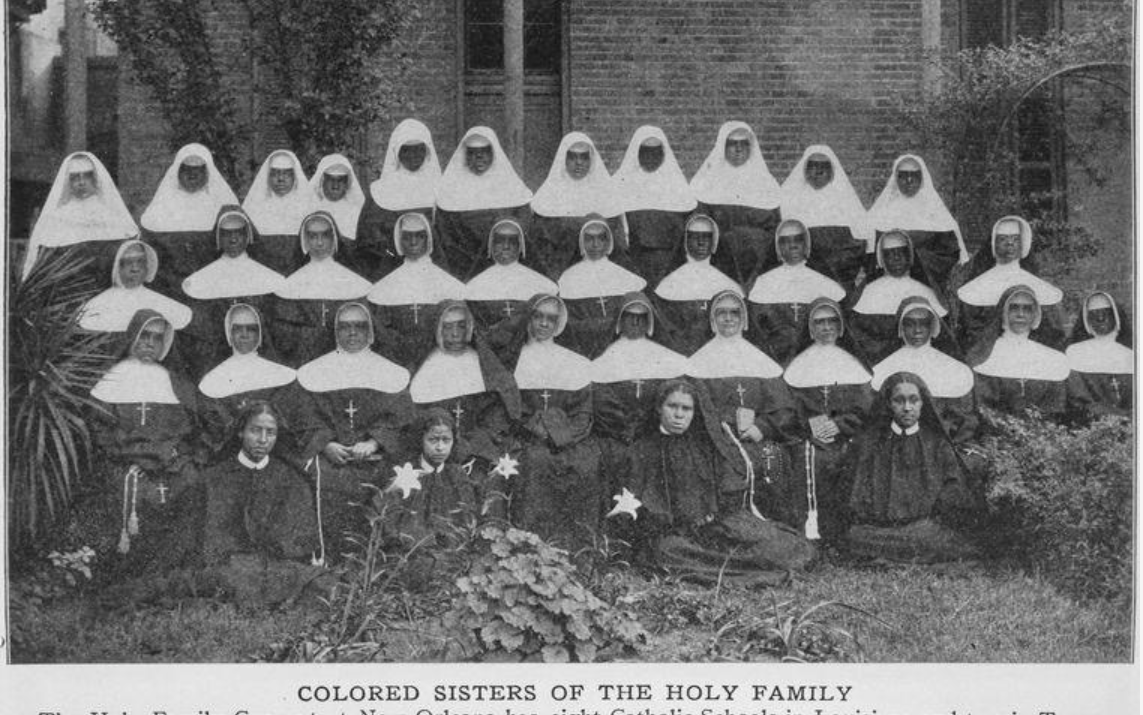
Catholic institutions provided another avenue for Black women's political work. The Sisters of the Holy Family, a religious order founded in 1842 by Henriette Delille, a free woman of color, established schools and charitable institutions that served both free Black people and enslaved individuals. Delille's founding of the order was itself a radical act; the Sisters taught enslaved people to read at a time when doing so was prohibited by law, holding daytime classes for free people of color and evening sessions for the enslaved. These schools educated generations of Black Louisianans and served as incubators of leadership that would prove crucial in later decades.
Their work demonstrates a pattern that would recur throughout Louisiana history: when Black women were excluded from political institutions, they built their own. Schools, churches, mutual aid organizations, and community networks became places where leadership was cultivated, and the foundations of political participation were established.
Reconstruction and the Architecture of Black Political Life
Black women in Louisiana were central to one of the most remarkable chapters in American democratic history, even though they remained formally excluded from the ballot. From 1865 to 1877 the Fourteenth and Fifteenth Amendments extended citizenship and voting rights to Black men, ushering in a period of extraordinary Black political participation in Louisiana. Black men served in the state legislature, on local juries, and as parish officials in numbers unequaled until the late twentieth century.
The political culture that made this participation possible was built and sustained in large part by Black women. They organized the political clubs, the churches, and the mutual aid societies that served as the connective tissue of Republican Party organizing in Reconstruction Louisiana. They attended political rallies in large numbers, sometimes outnumbering men. When violent white supremacist organizations like the White League and the Knights of the White Camellia terrorized Black communities to suppress voting, like they did on Easter Sunday in 1873, massacring approximately 150 Black men in Colfax, Louisiana it was often Black women who were among those who fearlessly rebuilt community life in the aftermath, often at great personal risk.
But that’s not all. Some Black women in Louisiana were publicly forthright about their desire for the vote. At Republican conventions and Freedmen's Bureau meetings, women demanded to be heard on political questions. While the historical record of individual voices is fragmentary, collective evidence makes clear that Black women did not passively accept their exclusion from formal political life. They understood themselves as political actors and engaged as such wherever the opportunity arose. This insistence on political personhood would fuel the suffrage activism of later decades.
Black women also exercised political power through the education system that emerged during Reconstruction. As teachers in the schools established by the Freedmen's Bureau, the American Missionary Association, and Black churches, they shaped the political consciousness of a generation. Education in the Reconstruction South was never merely academic; it was explicitly political, teaching formerly enslaved people the rights and responsibilities of citizenship. The women who taught these schools were themselves political educators in the fullest sense. Reconstruction provided an avenue for Black women to assert political authority in a society that sought to deny it, turning education into a form of resistance and a blueprint for a more just civic order.
Conclusion: Building the Foundations of Political Power
The first chapter of this three-part series reveals a central truth: Black women’s political power in Louisiana did not begin with the ballot. Long before Black women possessed federally protected voting rights, they were building the institutions, networks, knowledge, and community infrastructure necessary for political participation. Black women’s history in Louisiana demonstrates that political power has always encompassed more than access to a ballot. It includes the power to organize communities, build institutions, develop leaders, influence government, and secure meaningful representation. Understanding how Black women developed that power before they could vote is essential to understanding both what the Voting Rights Act ultimately protected—and what is at stake when those protections are tested today.

 via feedly