Oxfam’s 2026 Best States to Work Index shows how state policy shapes wages, workplace protections, and workers’ freedom to organize—and why workers in North Carolina and across the South are demanding change.
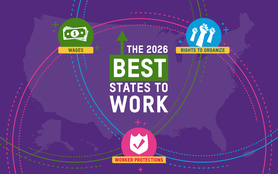
Last week, Oxfam America unveiled the 2026 Best States to Work Index, our ninth annual ranking of which states have laws that determine whether working people can earn fair wages, stay safe on the job, care for their families, and organize for better conditions.
The Index ranks all 50 states, the District of Columbia, and Puerto Rico—52 jurisdictions in all—on 37 policies across three core areas: wages, worker protections, and rights to organize. Its findings reveal a widening geographic divide in what workers can expect from their jobs and their state governments.
This year, the top five states are California (#1), the District of Columbia (#2), New York (#3), Illinois (#4), and Oregon (#5). The bottom five are North Carolina (#52), Alabama (#51), Mississippi (#50), Tennessee (#49), and South Carolina (#48).
The difference is not accidental. It is the result of choices policymakers make.
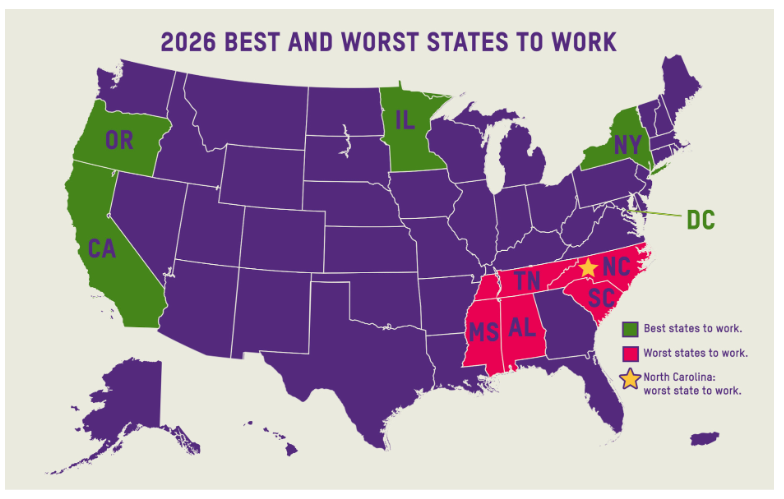
The five highest-ranking jurisdictions have some of the country’s strongest minimum wages (at least $15 an hour), and all protect child labor standards and teachers’ collective-bargaining rights. Four states guarantee both paid family and medical leave and paid sick leave. California, which earned the highest overall score, has enacted a broad set of protections that includes paid leave, heat protections, warehouse-worker safeguards, and protections against intrusive workplace surveillance and automated decision-making. California and Oregon are also “one fair wage” states, meaning they have eliminated the subminimum wage for tipped workers.
At the other end of the rankings, the Bottom Five states share a policy landscape that leaves workers exposed. North Carolina, Alabama, Mississippi, Tennessee, and South Carolina all keep their minimum wages at the federal floor of $7.25 an hour. None requires paid family and medical leave or paid sick leave. None has statewide heat-safety or warehouse-worker protections. And each has so-called right-to-work laws that make it harder for workers to organize, bargain collectively, and fight for a meaningful voice on the job.
This year’s Index is being released as federal protections are moving in the wrong direction. The Trump administration has rolled back worker protections, weakened anti-harassment and overtime safeguards, and decimated federal agencies charged with enforcing workplace rights. Its actions have left workers—particularly women, workers of color, immigrant workers, and low-wage workers—more vulnerable to discrimination, exploitation, and economic insecurity. Meanwhile, the administration’s One Big Beautiful Bill Act marked a historic upward transfer of wealth away from low-income families, even as rising prices continue to squeeze household budgets.
The federal minimum wage has now been stuck at $7.25 for 17 years, the longest period without an increase since the wage was established in 1938. Adjusted for inflation, its value is at its lowest point in more than 75 years. Even in the District of Columbia, where the minimum wage is the nation’s highest at $18.40 an hour, it covers only 43 percent of the cost of living for a family of four supported by one worker.
That is why states must step up—and why the 2026 Index looks not only at long-standing labor protections but at emerging challenges workers face. This year, the Index newly assesses laws that protect workers from discrimination based on caregiving responsibilities, guard against workplace digital surveillance and algorithmic decision-making—often called “bossware”—and enable sectoral bargaining for rideshare drivers. These policies recognize the changing nature of work and the particular pressures facing caregivers, app-based workers, and people whose jobs are increasingly shaped by digital monitoring.
There are encouraging signs that workers and advocates are winning needed reforms. Virginia became the first state in the South to enact a statewide paid family and medical leave program. Maine extended the full minimum wage to farmworkers. Utah public employees won the repeal of one of the nation’s most restrictive public-sector collective-bargaining bans. Georgia climbed out of the bottom five after passing protections for paid lactation breaks, while Connecticut and Rhode Island adopted warehouse-worker protection laws. Massachusetts rideshare drivers formed the largest private-sector union recognized since 1941.
Advancing worker justice at the state level
North Carolina remains at the bottom of the Index for the sixth consecutive year—not because its workers lack ambition or work ethic, but because state policy has failed to meet their needs. As the NC State AFL-CIO explains, workers across the state are dealing with the direct results of decisions made in Raleigh. Lawmakers “never miss an opportunity to pat themselves on the back” for North Carolina’s reputation as one of the country’s most corporate-friendly states. But for working people struggling to afford essentials, he asks, “what exactly [do] working people have to celebrate?”
North Carolina bars cities from raising their local minimum wage, even where costs are higher. It has no statewide paid-leave guarantee for private-sector workers, and it maintains policies that weaken workers’ ability to organize. These choices affect people who repair jets, move freight, cook and serve food, care for patients, teach children, and cultivate the crops that feed their communities.
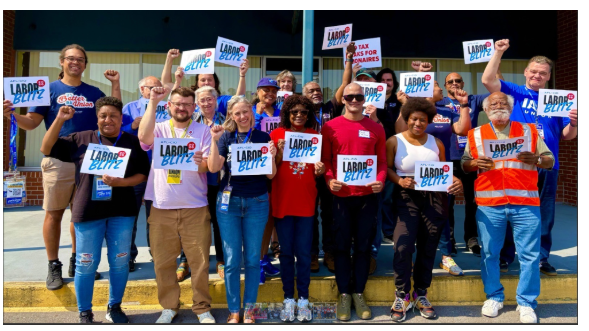
But North Carolina workers are fighting back. The state’s labor movement is organizing in every industry, opposing attempts to further entrench right-to-work—including SB 1082—and advancing racial justice, gender equity, and immigrant protections as essential worker issues. North Carolinians do not want to merely survive; they are organizing for a state where working families can thrive.
The 2026 Best States to Work Index offers a roadmap—and an imperative—for a race to the top. Strong labor policies are associated with lower poverty and food insecurity, higher median household incomes, higher GDP per capita, lower infant mortality, and greater unionization. A worker’s ZIP code should not determine whether they can afford the basics, take time to care for loved ones, remain safe on the job, or exercise their right to organize.

 via feedly