Black Women’s Equal Pay Day is not just about wages. It is about who gets access to good jobs, who gets promoted, who gets believed and whose labor is valued in the first place.
Black Women’s Equal Pay Day is a reminder of something many Black women already know in their bones: the fight for fair pay is not just about wages. It is about who gets access to good jobs, who gets promoted, who is worth believing, and whose labor is valued in the workplace.
Women’s labor has always been undervalued and undercompensated. The latest national data clearly shows that the broader wage gap is still moving in the wrong direction. According to the latest Institute for Women’s Policy and Research analysis, women working full-time, year-round earned 80.9 cents for every dollar paid to men in 2024, the worst annual ratio in nearly a decade and the second straight year of decline. That matters for all women; but for Black women, the gap is far more severe and far more entrenched.
A Black woman working full-time year-round earned 64.6 cents for every dollar paid to a white man in 2024, or $28,340 less per year. That is no small difference. It is the kind of gap that shapes whether a family can pay rent on time, cover child care, build savings or simply breathe without feeling constant financial strain.
And the problem is not only pay. In my research at the Maven Collaborative, we found that Black women are overrepresented in lower-paying occupations and underrepresented in higher-paying ones, even when we take into account their qualifications.
Black women are crowded out of opportunity by systems that continue to sort labor along racial and gender lines, a phenomenon researchers call occupational segregation. The analysis shows that, even when we take qualifications into account, Black women are crowded out of 58 percent of occupations nationally compared with white men, and many of those occupations are high paying ones like chief executives and management analysts. That means there are Black women who are qualified for higher paying roles but aren’t in them.
In other words, this is not about individual effort or credentials. This is about qualified Black women being shut out of jobs they should have access to. It means that “just get more education” is not a serious solution on its own, particularly when Black women bear the highest levels of student loan debt.
The wage gap follows Black women everywhere they go, even when they defy the odds to reach higher paying roles. In the study, we found that Black women in higher-paying occupations where they are underrepresented still earn only 71 cents on the dollar compared with White men. The issue is not simply getting in the door. It is what happens once Black women are inside: After fighting to get their foot in the door, Black women are forced to accept lower pay, stalled advancement, and too often, a workplace culture that still does not recognize their full worth.
I have been thinking a lot about that reality after a recent panel with Oxfam at Essence Fest in New Orleans. A Black woman came up to us after the event, and she was in tears. She lost her career as a federal worker and was struggling to make sense of what had happened to her life. This job loss was the result of the Trump Administration’s aggressive cuts to government employment that eliminated jobs with stronger union representation, wages, and benefits and were a source of stability for Black women. That moment stayed with me, as it conveys what data alone cannot fully express: these policies and practices are not abstract. They are being lived by real people, in real time.
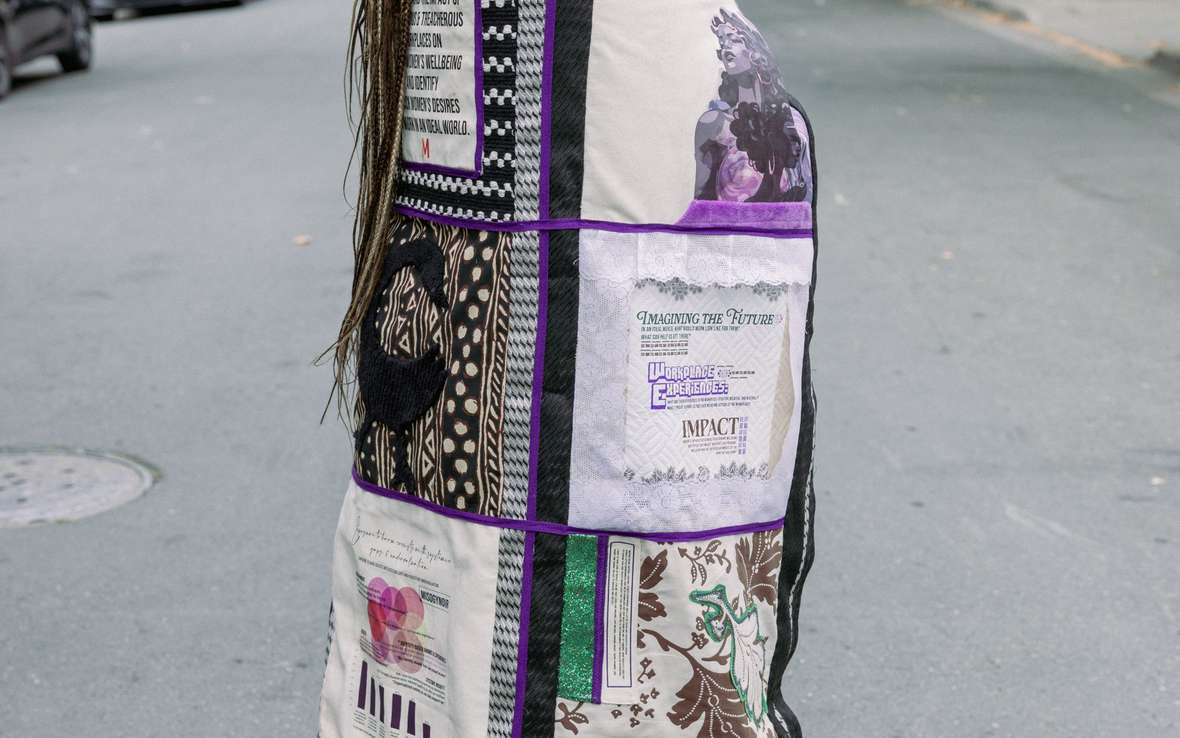
That is part of why the quilt means so much to me. The Maven Collaborative contracted Dr. Joanna Jenkins, an esteemed scholar-practitioner in visual culture, to turn our findings into something visual and human. The quilt reminds us that this research is not just numbers on a page. It is a collective portrait of Black women’s work, endurance, and brilliance — stitched together from lived experience, data and truth. To see more of the process of creating it, check here It is crucial to note that the wage-gap data does not fully capture the damage Black women have faced since Trump took office. Black women with a college degree and Black women working in the federal government lost the most jobs. IWPR reported that Black women lost a net total of 113,000 jobs in 2025, and that they experienced a decline of over 30 percent in federal employment. When public-sector jobs disappear, Black women lose more than just income. They lose stability, professional momentum and a pathway to financial security.
This is where Black women’s equal pay becomes broader than pay alone. It becomes a story about occupational segregation, hiring discrimination, performance evaluation and promotion bias and the public policies that either protect people or push them out. It becomes a story about the false idea that the market is neutral when the market has long rewarded some workers and undervalued others.
In our research, I heard Black women describe the emotional labor, unpaid care labor, and leadership they provide every day, often while being underpaid and overlooked. I heard women talk about being the person everyone turns to, the person who holds teams together, the person who keeps giving even when the institution gives back so little.
The policy implications are clear. We need stronger enforcement against discrimination in hiring and promotion. We need pay transparency. We need an end to salary history practices that lock inequity into place. We need public-sector jobs and safety nets that support workers instead of abandoning them. And we need leaders to stop treating Black women’s exclusion as accidental when it is so clearly structural.
Black women deserve more than survival. They deserve fair pay, real opportunity and the freedom to move through the labor market without being punished. That is what Black Women’s Equal Pay Day should remind us not only what Black women are owed, but what the economy owes to itself if it wants to be just, functional and whole.

 via feedly