Ten years ago, the World Humanitarian Summit set forth important and necessary commitments to advance local humanitarian leadership, one of which includes providing 25% funding direct to local actors.
This post is part of the Localization (R)evolution blog series, exploring why locally led humanitarian action – rooted in power, rights, and accountability – is essential to transforming the humanitarian system (read the introduction here and other posts in the series here).
On this target, it has been a massive failure. As of 2026, only 8.7% (indirect and direct) funding has reached local responders. This failure has real consequences. Without access to direct, flexible, and predictable funding, local actors’ ability to respond to emergencies is constrained. And for women’s organizations – already underfunded and underrecognized – the barriers are even higher. Often, we hear a mile-long list of reasons why it is so difficult to get direct funding to local actors. But what happens when we try to do things differently?
The System as the Problem
Direct, quality funding to local actors remains limited – not due to a lack of capacity on their part – but because of the colonial aid system that imposes complex and costly compliance requirements on local, mostly Southern-based responders.
Based on a series of interviews conducted for a recently published Oxfam report, one local partner from Bangladesh explained,
Sorry, for amounts smaller than $50,000, if you channel it directly to us, we will have to [obtain] government approval for a specific location, NGO and timeline, hire an external auditor, pay various taxes and meet other compliance [requirements]. It will be too costly and time-consuming for us [for small grants].
And as shared by an Oxfam colleague,
We have three donors [that are] very much impressed. They want to send money. However, [our] local partner does not have a 501(c)(3) certificate [an official US Internal Revenue Service document which formally recognizes an organization as a tax-exempt nonprofit in the United States] so our donors cannot donate to them directly.
These are not isolated examples. They reveal a system that makes it easier for international organizations to navigate compared to small and medium-sized local actors.
Our Approach: Emergency Response Fund Agility
In response to these challenges, Oxfam launched the Emergency Response Fund (ERF) Agility in 2021. The ERF Agility was designed as a pilot funding model to address challenges in humanitarian funding and leadership for local actors. It was developed to support locally led emergency responses through nimble funds that enable a rapid response within 72 hours of crises, especially underfunded and off-the-radar emergencies. (See here for our recently released report on the ERF Agility project).
Established in Bangladesh, Puerto Rico, and Uganda, the ERF Agility had four innovative design considerations:
- Be locally led and managed. Oxfam did not make any decisions but instead stayed in the background to provide technical and administrative support as needed.
- Require the inclusion of women’s organizations in the fund leadership and decision-making process. It was not enough for women’s organizations to receive funds; we also wanted them to be part of the steering committee itself. Over 50% of participating organizations were women-led, driving more inclusive and effective responses across all contexts
- Simplified compliance and emphasized community accountability. We minimized compliance and reporting requirements and enabled community feedback to ensure quality.
- Embrace the spirit of innovation and experimentation. Recognizing that this was a pilot, we wanted to ensure we were testing and adjusting approaches, and we were capturing key learnings throughout the project.
We worked primarily with networks: In Bangladesh, we worked with the National Alliance of Humanitarian Actors Bangladesh (NAHAB) and the Bangladesh Women’s Humanitarian Platform. In Puerto Rico, we partnered with Coordinadora Paz para las Mujeres (CPM), a network of organizations dedicated to addressing the issue of gender-based violence (GBV). In Uganda, we engaged with the Western Uganda Humanitarian Platform (WUHP) (see here for a post on the WUHP’s experience with the ERF Agility).
Across all three contexts, from 2021 to 2025 with total response funds of around $285,000, about 4,500 households were reached. These response funds were also accompanied by learning and institutional funding support in total of $130,000 for all three consortia and additional technical support from Oxfam staff and other allies.
What would a Locally Led Humanitarian System Look Like?
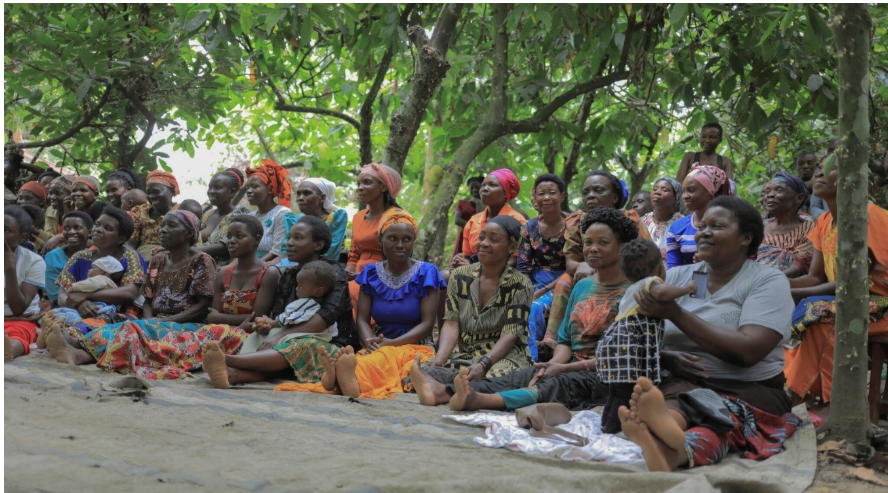
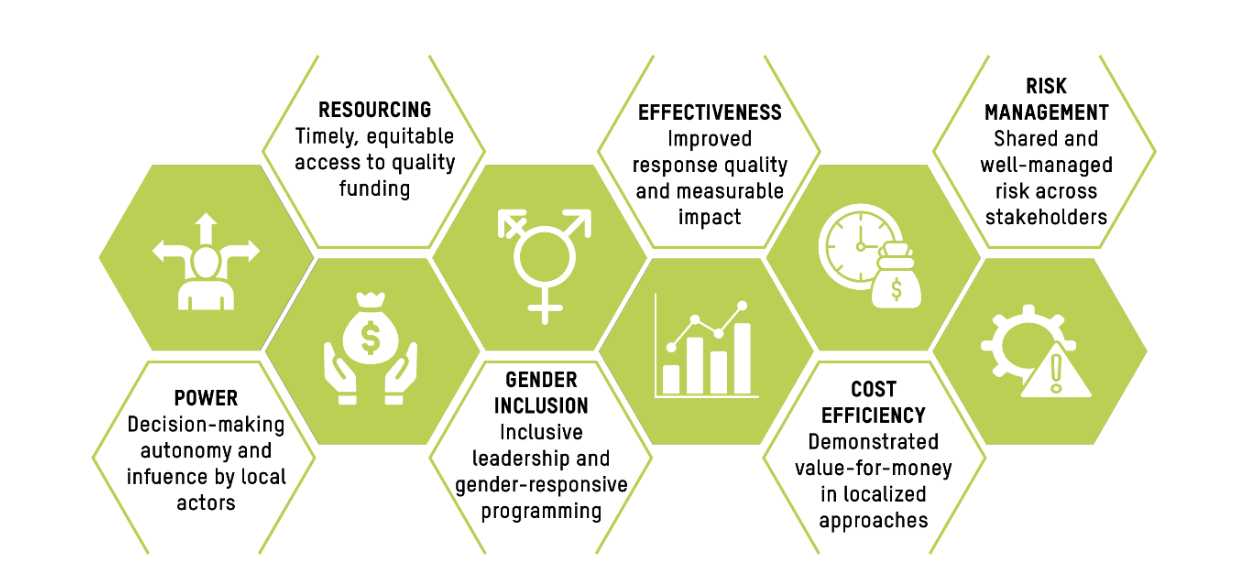
The ERF Agility evaluative research report finds that when local groups lead the response, aid can be faster, more appropriate to community needs, and more inclusive, especially for women and marginalized groups. The ERF Agility demonstrated the following results (see below graphic):
Redefining Emergency: Through a Local Partner’s Eyes
One of the most compelling stories from Oxfam’s ERF Agility effort comes from Centro Paz para Ti, the first community-based direct service project of CPM, located in a repurposed public school in the rural, mountainous town of Adjuntas, Puerto Rico. The center’s mission is to support rural women facing GBV by creating a safe, supportive space where women can build mutual aid networks and pursue economic independence.
Following Hurricane Fiona and in preparation for the 2024 hurricane season, the center needed a portable solar battery which would ensure uninterrupted access to essential services such as meals, electricity, and support for GBV survivors, even during power outages. Such a crisis normally does not qualify as an “emergency,” and organizations would not typically receive “humanitarian” funding to purchase such batteries. However, through the ERF Agility, the center reframed what counts as a humanitarian issue: treating GBV as an issue requiring emergency support and was able to secure the solar battery. With restored confidence in its emergency infrastructure, the center is now applying for additional funding to expand its services, including food storage and summer nutrition for children of single mothers.
“Thanks to this grant, the center managed to continue offering an accessible and secure space for survivors and we are no longer at the mercy of Puerto Rico’s unstable electrical system or the frequent disasters that disproportionately affect rural, marginalized communities,” according to one of the project officers of Centro Paz para Ti.
Ongoing Challenges
The study also highlights ongoing challenges in making a truly locally led ERF a reality, such as difficulties in sending funds directly to local organizations, limited long-term funding, and the need to better support the safety and wellbeing of frontline workers. Additionally, one of the main gaps in the ERF Agility is risk management: it largely focused on risks to project delivery and participants, with less attention to the safety and wellbeing of local staff. This gap highlights the need to expand risk management to include fair working conditions, protection, and adequate support for local responders. This is an important issue that the whole humanitarian sector must address.
A Possible Way Forward
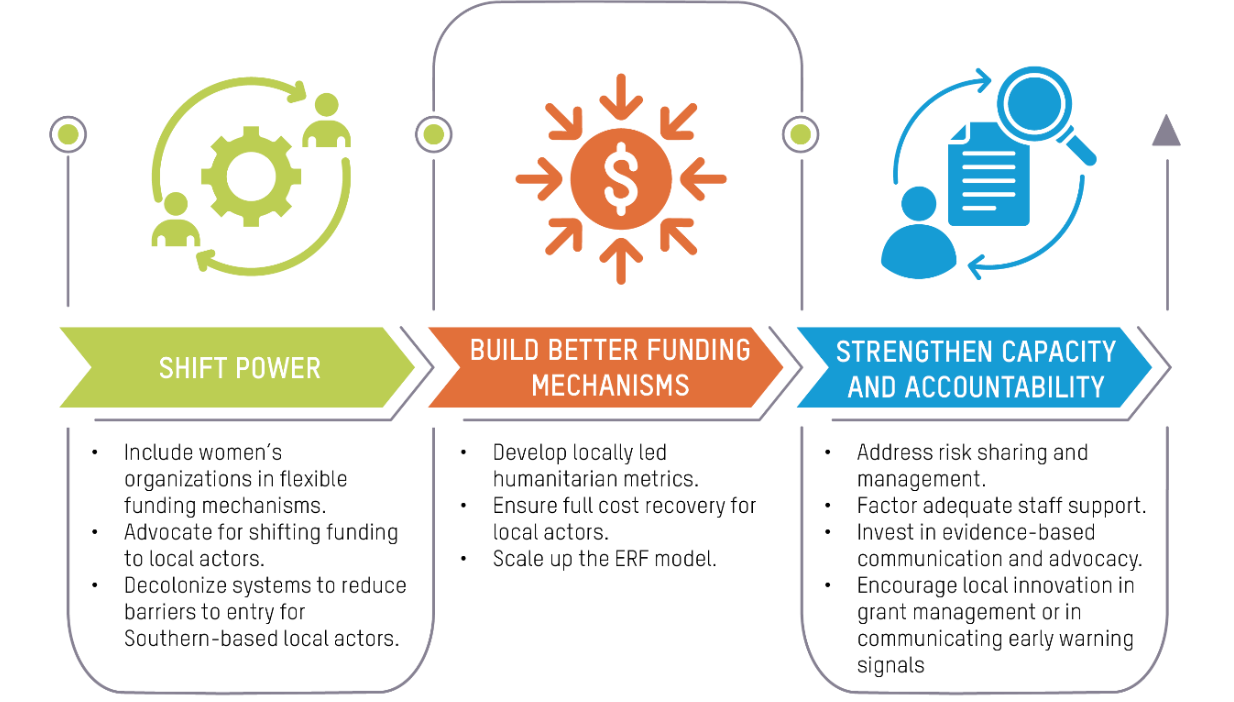
How can we create a sustainable humanitarian system? Imagine if more donors pooled resources to support locally managed funds like ERF Agility. Imagine a system where local organizations do not just respond to crises—but shape the entire humanitarian agenda. The below graphic signals what we need to do:
Most importantly, we need to move beyond pilots, and we need to start now. There will always be challenges but what ERF Agility showed us is how to counter an analysis paralysis with a spirit of innovation jointly embraced with local actors. We may never have the perfect environment to direct funds to local actors. But we need to start chipping away at the barriers, look at solid entry points, and allow for some experimentation and joint problem solving with local actors themselves.
 via feedly