In the broader conversations on localisation, the global commitments and local/national- level implementation take the centre stage with often lesser attention to the regional level, yet it is a space where power, policy and practice can be shaped.
This post is part of the Localization (R)evolution blog series, exploring why locally led humanitarian action – rooted in power, rights, and accountability – is essential to transforming the humanitarian system (read the introduction here and other posts in the series here). In honor of World Refugee Day, we are sharing this blog post by Oxfam’s Abbas Kigozi on the importance of regional mechanisms in advancing refugee leadership.
In Africa, mechanisms such as the International Conference of the Great Lakes Region show that regional bodies can help move refugee leadership from rhetoric to reality by opening decision making spaces, recognising refugee networks and connecting lived experiences to political processes.
The Missing Regional Dimension in Localisation
In the decade since the World Humanitarian Summit, there has been tremendous progress made towards localisation, but the humanitarian system has fallen short on its goals of change. There has been a progressive increase in participation of local and national actors in some contexts, but it has not yet resulted in a consistent transfer of decision-making power. By 2024, 7.5% of total humanitarian funding (US$2.5bn) was directly or indirectly allocated to local and national actors, which is still well below the 25% aggregated target. Refugee leadership faces an even bigger challenge. Refugees’ opinions are often solicited but they are rarely trusted to lead discussions or shape policy even when such policies are about fundamental issues to their rights and well-being. Refugee Led Organisations (RLOs), continue to be sidelined and excluded from international funding streams.
The localisation debate has largely been framed from a global and national/local binary lens that often includes the African Union but pays less attention to other important regional layers. In Africa, regional intergovernmental organisations like the International Conference for the Great Lakes region (ICGLR) play an important role. They shape political norms, convene states and create spaces where displacement, protection, and durable solutions can be discussed in ways that reflect shared realities.
The ICGLR and Why the Region Matters
The ICGLR brings together 12 member states across the Great Lakes region to promote peace, security, democracy and development. It was established following the United Nations Security Council resolutions (1291 and 1304) in 2000 and four years later, the member countries unanimously adopted the Declaration on Peace, Security and Development in the Great Lakes region.
Forced displacement in Africa is a regional issue. Refugees often cross borders and host communities across the entire region feel the impact. It is therefore essential when talking about local humanitarian action to also consider the regional institutions that shape it. If localisation is about shifting power closer to affected communities, then regional mechanisms deserve far more attention.
Up until 2023, the ICGLR did not have direct meaningful engagement with RLOs. Oxfam, through its membership in the Regional Durable Solution Secretariat (ReDSS) and close collaboration with the ReDSS Great Lakes Unit, has contributed to changing this situation. The ICGLR is now a space where RLOs’ voices influence discussions and decisions often dominated by states and international organisations. The ICGLR has provided a space where displacement is discussed as a shared regional concern rather than only a national burden. This has enabled the centring of those most affected, including through the participation of refugee-led networks like Refugee Led Organization Network (RELON) Uganda, RELON Kenya, RELON Burundi, RELON South Sudan, and members of African Refugee-Led Network in conversations about solutions. This entry point has helped progressively move refugee participation beyond token consultation and toward consistent recognition.
Emphasizing this point of recognition is a quote from Jerry Mbokani, Executive Director of RELON Uganda:
Regional mechanisms like the ICGLR are not just diplomatic forums. They are the spaces where governments make commitments that directly shape the lives of millions of refugees across borders. When we talk about localisation, we often focus on the relationship between international NGOs and local actors within a single country. The most consequential decisions, however, about refugee rights, freedom of movement, and durable solutions in Africa are made at the regional level, where heads of state and ministers sit together.
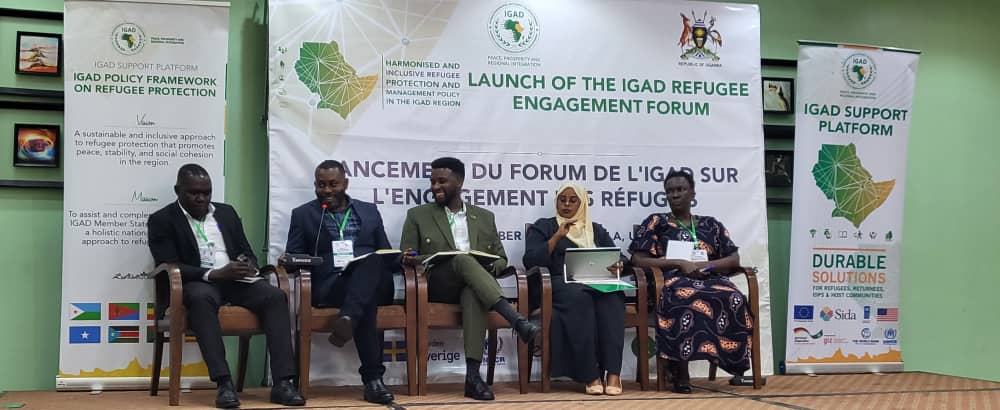
For example, since 2024, RLOs have been asked to speak and contribute during different ICGLR meetings. They are also members to the Regional Advisory Group, a platform created to strengthen dialogue between civil society and the ICGLR and ensure that local civil society actors from the Great Lakes region can help shape and validate the Regional Strategy on Comprehensive Durable Solutions for Refugees.
RLOs have, indeed, directly contributed to the ICGLR Regional Strategy on Comprehensive Durable Solutions for Refugees in the Great Lakes Region and have taken part in its validation. The strategy aims to improve cooperation and coordination among ICGLR member states on refugee protection, while encouraging more consistent, rights-based and development-oriented approaches across the region.
These are not small achievements. In a sector where refugee leadership is still often discussed in principle and resisted in practice, being present in regional spaces matters. It signals that refugees are not only beneficiaries of policies but participants in shaping it.
According to Narcisse Bakouroua Francois, Executive Director of Youth Association for Peace and Development and RELON South Sudan:
Since we began engaging with ICGLR, our organization has gained greater visibility, recognition, and a stronger voice at regional level. As an RLO, this platform has allowed us to share our lived experiences, contribute to policy discussions, and be seen as credible partners rather than just beneficiaries.
From Access to Influence
It should be noted still that access to spaces such as the ICGLR is not enough. Refugee participation can quickly become symbolic if not backed by resources, continuity and accountability. Too often RLOs are invited to high- level discussions without funding, preparation, translation support, or follow up they need to participate equally. Simply giving refugees a seat at the table is not true localisation if they have little influence over the decisions.
For regional bodies to drive real change, they must move beyond occasional invitations to institutionalise refugee participation in decision making processes. This includes supporting diverse refugee groups especially those led by women, youth and persons with disabilities and ensuring that regional discussions lead to concrete national policy and practice change.
A Regional Agenda for the Future of Localisation
The future of localisation in Africa will not, and must not, be shaped only in global summits and donor capitals like Geneva or New York. It must also be shaped in regional institutions, economic communities and political platforms that can connect local leadership to structural change.
The ICGLR secretariat offers a case study that shows that regional spaces can be opened, that refugee networks can contribute, and that localisation can be strengthened when it is understood not only as a funding reform but as a question of power, legitimacy and voice.
If the humanitarian system is serious about reform, it needs to stop treating the regional level as an afterthought. In Africa, it may be the missing link that helps turn localisation into from a promise to practice.
 via feedly