Moving the focus of aid delivery from the perceived centres of power in the Global North to what have always been the centres of action in the Global South will take more than ‘localisation’ as it is practiced today. It will require supporting the diverse and multiple locally-led aid ecosystems that actually deliver on the ground.
This post is written by Vijayalakshmi Viswanathan, lead researcher and author of NEAR’s report, Building More Locally-Led Aid Ecosystems: 2025 Insights from Global South Civil Society. Drawing on the inputs and insights generated through this flagship research, the post highlights the lived realities and shared experiences that echoed across regions.
Whose ‘localisation’? A gap between rhetoric and realities on the ground
‘Localisation’ as a concept has become an accepted idea across the formal international sector. It has become the norm for international actors to build country-based expertise into proposals and plans (often asked for by donors); to implement projects through national and local actors (with the cost efficiency and access arguments still at the forefront); or (to a lesser extent) give visibility to their ‘local partners’.
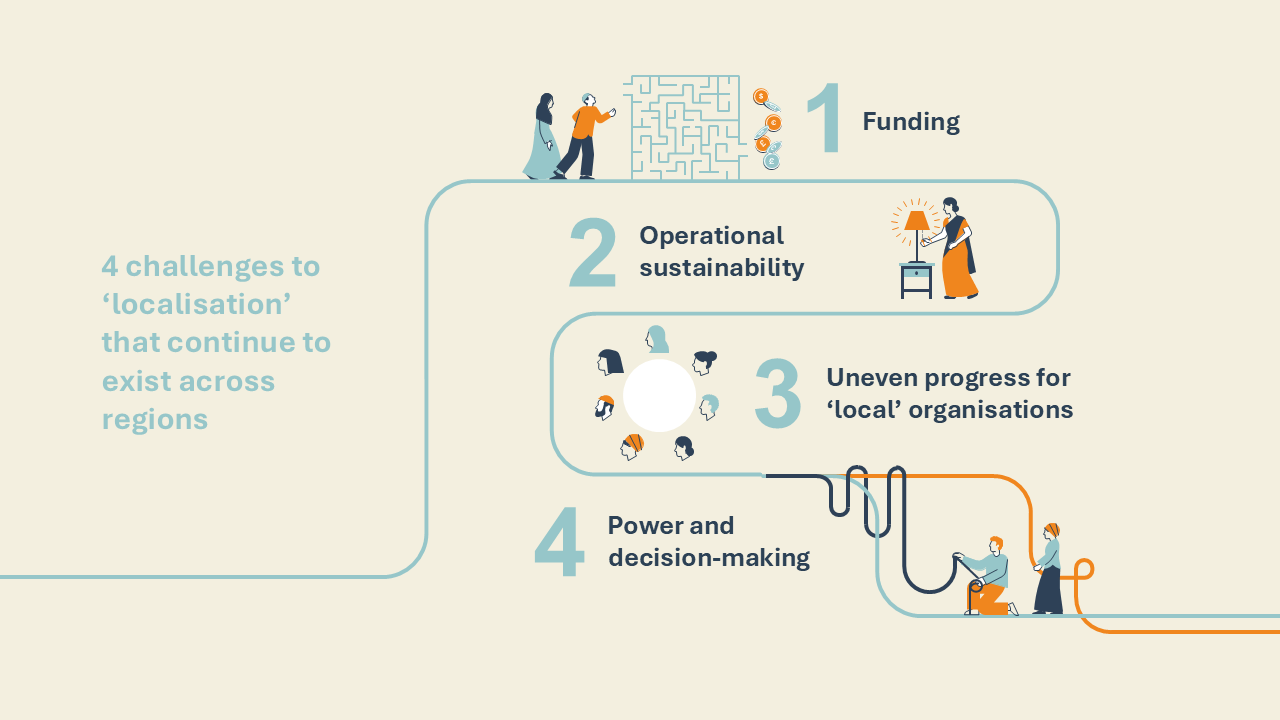
Despite efforts to broaden and deepen the idea of localisation, progress has primarily been measured by direct-as-possible funding and representation in coordination systems. These have therefore dominated conversations. While important and necessary, even these two indicators have not moved much. Representation continues to feel tokenistic, and across the humanitarian system only 3.6 per cent of all funding went directly to local and national organisations in 2024.
These narrow focuses also have a limiting effect on how ‘localised’ aid delivery continues to be perceived – as a top-down system following the traditional flow of money from donor to UN/INGO intermediaries to national/local partners and so on. As a national practitioner from Yemen commented, “We are not yet ready to practice the true definition of localisation – it remains a fundraising place, a place to practice the Grand Bargain. If you don’t like it and there is another local organisation who is willing to compromise, then many donors have taken advantage of it.”
There’s a lot that happens beyond the international system’s gaze.
In reality, and in the majority of crises, national, local and grassroots organisations are delivering on the ground regardless of international assistance or funding. Often in extremely difficult circumstances with little serious discussion of the physical, mental, financial and social toll on those doing the work.
In the remote region of Chocó, Colombia, a group of community practitioners are running a now peer-supported mental health clinic. Defunded and shut down after USAID closed, they saw no choice but to keep a safe space for women going. “In Chocó, we live in emergency 360 days a year,” they commented, “and it is not just water and livelihood. Obstetric violence, gender violence. These are real needs but there is not much interest in funding them.”
In the Philippines, grants from the Abot-Kamay Community Solidarity Fund administered by a national NGO attempt to resource relationships, not just projects. For example, the Kilometer 7 Farmers-Producers Cooperative in Butuan leveraged its grant to access an additional PHP 10 million (over $160,000) in government support, organising 13 new farmer groups within a year. A women’s cooperative in Batangas turned its small savings group into a registered enterprise. An Indigenous Person’s group in Palawan used the grant as a counterpart to its internal funds.
Across India, the Akshvi initiative is building digital public infrastructure to respond to climate losses as areas are hit repeatedly before a recovery cycle is even complete. It is a self-reporting tool for every time families are faced with an incident, integrating both economic and non-economic losses. The idea is a database of hyperlocal data to better tailor response, as well as a e-disaster wallet that will allow for faster disbursal of funds. The initiative is anchored by a national NGO and is currently being tested in partnership with the government, private sector and other civil society organisations. Ultimately, it is envisioned as a collective of grassroots organisations, with credentialed frontline workers helping feed in and verify data, while also being linked with insurance and social welfare schemes.
These are just a few examples, but they underscore a common truth. They don’t fit neatly into the types of silos that are commonly used in the international aid sector.
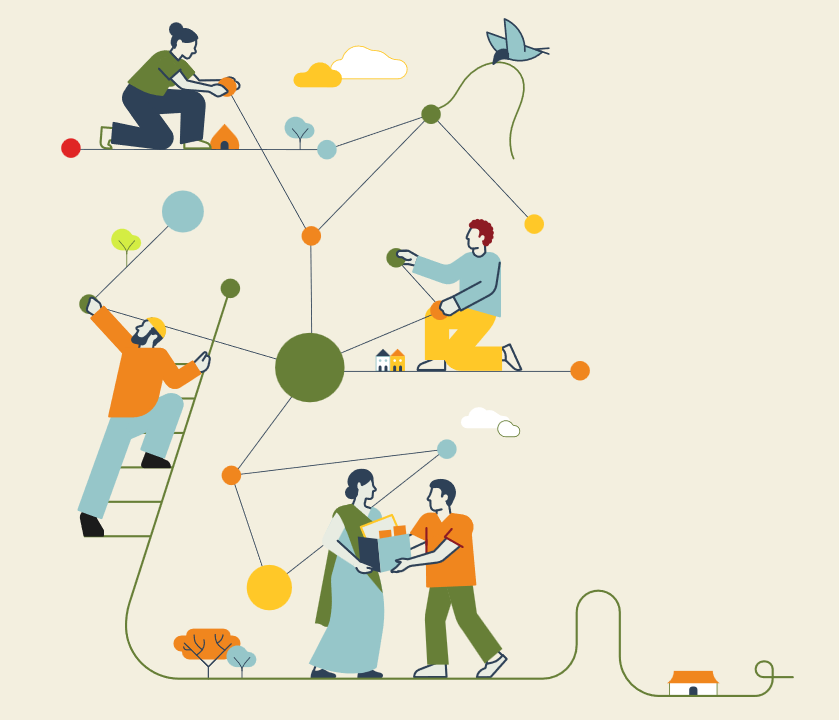
In fact, locally-led initiatives exist within and build upon multiple intersecting ecosystems, not a single formal system. These overlapping ecosystems define the daily realities of Global South civil society. Insights from this study reinforced the multitude of stakeholders, issues, complexities and opportunities in one country, let alone across the entire Global South. For example, despite the number of challenges around civic space, respondents were clear that Global South governments – particularly at the local level – had a critical role to play.
Emerging systems will have to be more decentralised.
A key part of this is building upon what already exists. As observed in crisis after crisis, communities and local organisations have responded long before a donor, any donor, arrives. This ethos of community solidarity, relational being and mutual support is embedded in many places. Yet, the time, resources, space, intellectual capital, labour and in-kind materials that people put in themselves are rarely acknowledged. Non-monetary assets, support and services are still systematically undervalued within the formal aid systems we know.
So, the way forward needs fundamental mindset shifts, not just technical fixes.
Tinkering around the edges of the dominant system is not enough, particularly given the changing and shrinking funding patterns, the inability (or unwillingness) of the formal system to exert political will, and the growing clampdown on civic space.
Hopes for the future will require shifts in our conception of what a ‘system’ looks like, and a concerted effort to look more holistically at issues. And addressing root causes cannot occur independent of rights building – both inherently political choices. It will also require the norms, incentive structures and ways of working themselves to shift, not just the actors involved.
What is valued – only scale, technical knowledge and money, or also solidarity, lived expertise and non-monetary resources? What defines success? How are these reflected in monitoring, administrative and fiduciary frameworks? And who gets to make decisions around defining these?
Walking a different path will require sacrifices and difficult decisions, but also an ability to dream. In the words of a community philanthropist, “the new systems must be built from the heart, as well as the head.”
 via feedly