The most celebrated data point in India's recent employment story — the sharp rise in rural women's workforce participation — may be the least understood.
The author recently published a policy paper on India’s Female Labour Force Participation. This is a Four-part blog series on key aspects of the paper. Blog# 4
The most celebrated data point in India's recent employment story — the sharp rise in rural women's workforce participation — may be the least understood. This piece makes the case that much of this spike is not a story of opportunity but of distress: women entering self-employment and agricultural work as a coping response to household economic stress, not as a sign of expanding choice. It's a harder, less comfortable story than the one usually told about this number, and a necessary corrective to it.
Over the past seven years, India has recorded one of the sharpest increases in female labour force participation (FLFPR) anywhere in the world, and almost all of it has happened in the countryside. Rural FLFPR rose from 24.6% in 2017–18 to 47.6% in 2023–24, nearly doubling, with a single-year jump of 6.1 percentage points between 2022–23 and 2023–24 alone. Urban FLFPR rose too, but far more modestly, from 20.4% to 28% over the same period. On the surface, this looks like a landmark moment for women's economic inclusion in India. Look closer at what kind of work is driving the numbers, however, and a more troubling picture emerges — one that a growing body of economists argues reflects distress rather than genuine empowerment.
The heart of the story is not that more women are being hired. It is that more women are being counted as "self-employed," a category that in India's Periodic Labour Force Survey (PLFS) covers everything from running a shop to unpaid work on a family farm. Among rural women, the self-employed share of the workforce rose from 57% in 2017–18 to 72.2% in 2023–24. Within that group, unpaid family labour still accounts for 59% of self-employed rural women, while regular salaried work fell from 11% to 8% of all employed women, and casual labour fell from 32% to 20%. In other words, as women have moved into work, they have moved out of the categories that typically come with a wage, a contract, or any security, and into unpaid or precarious own-account roles.
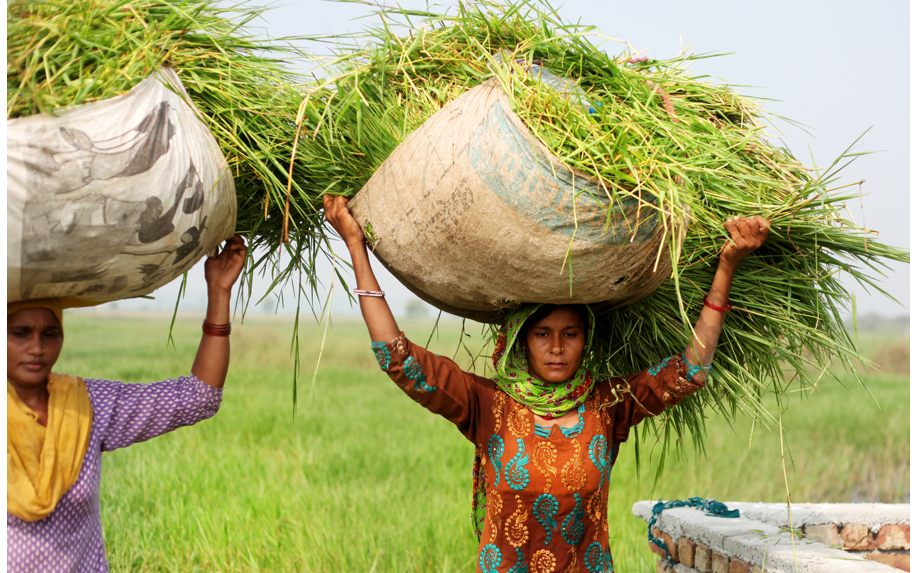
Much of this shift is a return to the land. The share of own-account women workers engaged in agriculture and allied activities climbed from 62% to 70% between 2017–18 and 2023–24, and roughly 40% of illiterate rural women in the workforce are self-employed in agriculture. Economist Sona Mitra has argued that the rise in FLFP is essentially a story of women crowding into self-employment in agriculture — not evidence of new opportunity, but a sign that no other suitable work exists for them. Independent research points the same way: an analysis of the trend found that India's rising female labour force participation, led by rural women, largely reflects economic distress, unpaid work, and informal jobs, with women moving back into agriculture rather than diversifying out of it, even as their presence in industry and services has declined. Notably, the share of women reporting "domestic duties" fell sharply while those working as unpaid helpers in household enterprises or as own-account workers rose— evidence, in this reading, of a shift from unpaid housework to unpaid or barely-paid self-employment rather than a shift into secure income.
Not every economist reads the numbers the same way, and the debate matters for how the trend should be interpreted. Some researchers have raised the possibility that part of the 2023–24 jump reflects a change in how PLFS enumerators were instructed to classify women's activities, reclassifying women previously seen as outside the labour force as self-employed, which would inflate the apparent rise without a corresponding change in women's actual economic lives. Others argue the classification question and the distress story are not mutually exclusive: even accounting for measurement effects, the underlying data still show falling real earnings among self-employed women in the very activities driving the increase, suggesting the growth is not a "pull" into better opportunities but a "push" born of economic necessity.
A third strand of expert analysis, associated with economist Ashwini Deshpande, locates the deeper cause on the demand side of the economy rather than in women's own choices or survey design. Her research contends that India's growth has shifted employment from agriculture toward capital-intensive services that generate relatively few jobs, so that even as GDP, education, and health outcomes have improved for women, the economy has not produced enough non-farm work to absorb them — leaving agriculture, and self-employment within it, as the fallback. This demand-side account helps explain a striking companion statistic from the same PLFS data: unemployment among educated rural women has actually risen even as overall participation climbs, pointing to rising aspirations for work that the rural non-farm economy simply cannot meet.
The burden of this "spike" is not evenly spread. Uttar Pradesh has emerged as the epicentre, home to roughly 17% of India's self-employed women, 91% of whom work in agriculture. Among self-employed women in the state, 51% are illiterate, over a quarter belong to the poorest economic class, and 87% belong to marginalised social categories — Other Backward Classes and Scheduled Castes together. This is not a generalised rise in opportunity; it is concentrated among the most socially and economically disadvantaged women, for whom the absence of land titles in their own names compounds the problem, cutting them off from credit, inputs, and markets even as they do the physical labour of farming.
Policy is compounding rather than cushioning this shift. MGNREGA, which historically made women net gainers in paid rural work and where women made up 54% of person-days worked, has been scaled back in favour of the new Viksit Bharat-Guarantee for Rozgar and Ajeevika Mission Gramin (VB-GRAM-G) Act. The related budget line fell from ₹40,000 crore to ₹13,956 crore even as a differently structured ₹44,506.49 crore allocation was introduced elsewhere. Unlike the old demand-driven guarantee, the new scheme rations work to specific seasons, shifts 40% of the wage bill onto states — many of them fiscally stressed — and requires twice-daily geo-tagged photo uploads through a mobile app, a barrier for women with limited digital access and skill. In a recent Indian Express Op-Ed piece by Nikhil Dey and Aruna Roy, the authors have shown that in July 2026, rural non-farm work through VB-GRAM-G has fallen 50% year-on-year. As structured public employment recedes, the pull back toward unpaid family farming looks less like choice and more like the only option left.
The rural employment spike is real, but "employment" undersells what is happening. Millions of Indian women have entered a labour force that offers them agricultural fields rather than paid jobs, unpaid family roles rather than wages, and, for the most disadvantaged among them, farms they cannot legally claim as their own. Whether the statistical jump owes more to survey reclassification, economic distress, or a structural mismatch between women's aspirations and the jobs the economy creates, the underlying consensus among researchers is consistent: rising participation has not yet translated into rising economic security for rural Indian women.
 via feedly