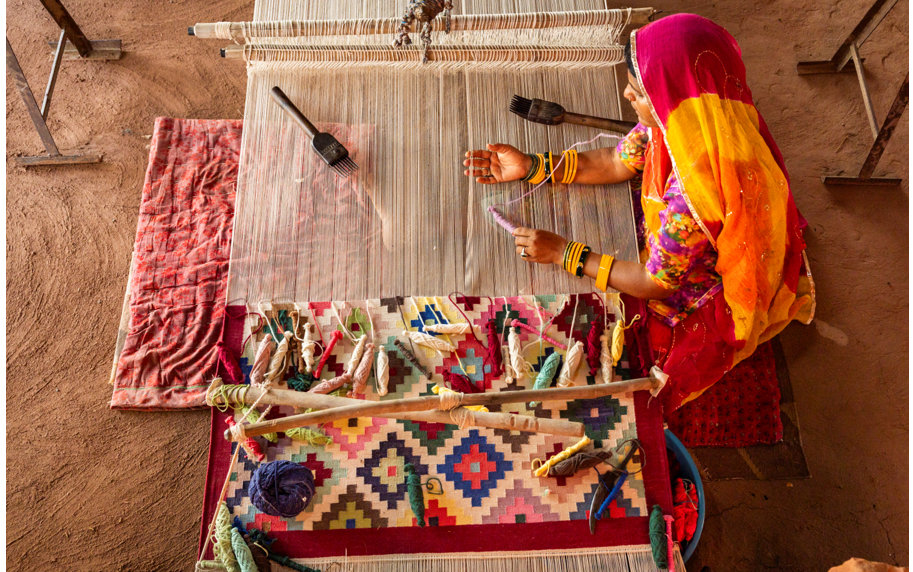
Between "unemployed" and "salaried" lies a vast, poorly understood middle where most working Indian women actually are; running or working in family enterprises, doing piece-rate or home-based work, often without financial or business training.
The author recently published a policy paper on India’s Female Labour Force Participation. This is a Four-part blog series on key aspects of the paper. Blog# 3
Between "unemployed" and "salaried" lies a vast, poorly understood middle where most working Indian women actually are; running or working in family enterprises, doing piece-rate or home-based work, often without financial or business training. This piece looks at what holds this sector back — the absence of financial management skills, and dependence on middlemen — against what unlocks it: something as simple as owning a phone, which lets women reach markets directly and cuts out the middleman that has historically captured most of the margin. It also examines how exposed this segment is to both economic and health shocks, with no cushion to absorb any of them.
India's Micro, Small, and Medium Enterprises (MSME) sector — home to roughly 63-64 million enterprises contributing about 30% of GDP, over 40% of exports, and jobs to 110-124 million people — is undergoing a quiet but consequential transformation: the entry of women as owners and operators of formal enterprises at a scale not seen before. Women with middling levels of educations—a 12th standard pass or a mere graduate pass, who don’t find suitable jobs in the employment market, are finding new avenues to earn income in the MSME sector. At the centre of this shift sits India Stack, the layered digital public infrastructure built around Aadhaar (identity), UPI (payments), Jan Dhan bank accounts, and increasingly the Account Aggregator and ONDC frameworks (data and commerce). Together, these rails are lowering the fixed costs of formalising, transacting, and borrowing that historically kept women entrepreneurs locked out of the mainstream economy.
How India Stack Is Enabling the Shift
The "JAM trinity" — Jan Dhan, Aadhaar, Mobile — gave over 91% of Indian women a bank account, closing a gender gap in account ownership that was once among the widest in the world. Aadhaar-based e-KYC turned business registration from a paperwork-heavy, multi-week process into a same-day online task, which is a major reason the Udyam Registration Portal and the Udyam Assist Platform (for informal micro enterprises) have absorbed such a large wave of first-time women registrants: government data put women-owned enterprises on Udyam and Udyam Assist at over 30 million by early 2026, roughly 40% of all registered MSMEs, up from about 20% of the Udyam Registration Portal alone just two years earlier — with the bulk of that growth concentrated in the informal micro-enterprise segment.
UPI has been equally significant on the transaction side. Women vendors, tailors, and home-based food or craft sellers who once worked entirely in cash are increasingly accepting UPI payments, which does two things: it reduces the risks of handling cash (theft, spoilage of informal savings) and it creates a digital transaction trail. That trail is the raw material for "invisible" API-based lending — non-banking lenders and fintechs now assess creditworthiness using UPI and GST transaction histories rather than collateral or formal credit scores, which matters enormously for women who typically lack property titles in their own name. Schemes layered on top of this infrastructure — MUDRA (collateral-free loans up to ₹1 million, with women accounting for a majority of beneficiaries), Stand-Up India, and the Public Procurement Policy's 3% set-aside for women-owned micro and small enterprises — ride on the same digital rails for disbursement and monitoring. ONDC, the newer open commerce network, is beginning to extend this logic to market access, giving small women-run outlets discoverability on e-commerce without paying platform commissions designed for larger sellers.
What Kinds of Businesses Women Are Building
The composition of women-led MSMEs still reflects both opportunity and constraint. Historically, IFC research found about 78% of women-owned enterprises clustered in services, with roughly 98% classified as micro-enterprises — tailoring and garments, beauty and wellness services, food processing and catering, handicrafts and textiles, tuition and skills training, retail trade (kirana-style/grocery shops), and agro-based processing (papad, pickles, spices, dairy). More recent Udyam data shows manufacturing has grown as a share of women-led registrations too, particularly in food products, textiles, and apparel — sectors that build on traditional household skills but are now being formalised, branded, and sold digitally through platforms like Meesho, Amazon Saheli, and ONDC-linked marketplaces. Self-help group (SHG) federations, especially under the National Rural Livelihoods Mission, have also become a pipeline: SHG members are graduating from group-based subsistence production into individually Udyam-registered micro-enterprises, aided by digital onboarding.
The Job-Creation Potential
The employment case is substantial. Women-owned MSMEs on the Udyam and Udyam Assist platforms already account for close to 19% of employment generated by all registered units, and informal women-owned micro-enterprises make up over 70% of all enterprises on the Udyam Assist platform, which is specifically formalising previously invisible informal businesses. Women entrepreneurs have the potential to generate 150-170 million jobs in the MSME sector in the future. If India could close the roughly 25-30 percentage point gap between male and female labour force participation, estimates cited by IFC and other multilateral studies suggest this could add trillions of dollars to GDP. PLFS 2023-24 data shows female labour force participation rose from 23.3% in 2017-18 to 41.7%, with the increase overwhelmingly driven by self-employment (67.4% of employed women are now self-employed, versus 51.9% in 2017-18) — a trend consistent with more women converting informal, subsistence-level work into registered, digitally-enabled enterprise.
A Critique: The Limits of the Current Model
This growth needs qualification on several fronts. First, PLFS analysts and economists (including at the India Forum and Ideas for India) caution that much of the recent rise in female self-employment reflects a definitional and enumeration shift — more unpaid family labour and subsistence agricultural work is now being counted as "self-employment" — rather than a genuine structural expansion of remunerative entrepreneurship. Female salaried employment has actually fallen to a seven-year low. Second, the credit gap remains severe: despite digital footprints, IFC studies estimate that nearly 90% of women entrepreneurs have never accessed formal institutional credit, and the unmet financing demand for women-owned enterprises in India runs into tens of billions of dollars. Third, registration does not equal viability — most women-owned Udyam units remain micro (contributing only around 10% of turnover despite being 20%+ of registrants), concentrated in low-margin, informal, saturated segments like tailoring and food, with limited access to larger contracts, technology upgrades, or export markets. Fourth, benaami registration — enterprises registered in a woman's name to access subsidies while actually controlled by male relatives — dilutes both the data and the policy intent. Fifth, digital access itself remains uneven: rural and older women still lag in smartphone and internet access, and compliance anxiety around GST and digital paperwork disproportionately deters first-generation, semi-literate entrepreneurs. Finally, related to the previous point, lack of financial and digital skill training leaves these women dependent on male family members for financial management of their businesses as well as circumscribe their opportunities to grow their businesses.
Strengthening the Women-Led MSME Sector
Several steps could deepen the transformation beyond formal registration. Expanding cash-flow-based lending using UPI/GST data through the Account Aggregator framework and the Unified Lending Interface (ULI) can substitute for collateral more systematically. Bundling registration with structured handholding — mentorship, cluster-based skilling, design and quality certification — would help women move from micro to small-scale viability. Strengthening enforcement of the 3% public procurement mandate, and expanding ONDC-linked market access with logistics support, would open larger revenue pools. Financial and digital literacy programmes targeted at rural and semi-urban women, delivered through trusted SHG and community networks, remain essential to sustaining adoption. And routine, disaggregated tracking of women-MSME turnover, employment, and survival rates — not just registration counts — is needed so that policy can be judged on enterprise quality, not just headcount.
 via feedly