School and higher education is not translating into jobs for men and women, which is true for women more than men. Here lies the skilling paradox.
The author recently published a policy paper on India’s Female Labour Force Participation. This is a Four-part blog series on key aspects of the paper. Blog# 1
It is a commendable feat that girls are outperforming boys in school education In India. Indeed, the gender revolution in school education is worth celebrating. The unfortunate truth is, however, school and higher education is not translating into jobs for men and women, which is true for women more than men. Here lies the skilling paradox.
As per PLFS 2023-24 data, 81.1% women in the age group of 15-29, have received neither formal nor other forms of vocational training as compared to 67% of men in India. Social norms act as a critical barrier to women’s participation in skills training. But, larger macro-economic demand, namely the creation of adequate, stable and respectable jobs remains the biggest hurdle for women to take up skilling.
But first on skilling. There are several social norms which form a barrier to women’s effective participation. The first is the marriage penalty; contrary to other countries, in India, the first and foremost barrier is marriage and not motherhood penalty. The few women who do acquire a skilling certificate do so to improve their prospects in the marriage market and not for actual jobs. It reduces the burden of dowry rather than improving chances of being employed. There is also the status stigma where, as households move up the economic and social ladder, they withdraw women from the labour market and prefer they engage in social capital generation by guiding children’s education and being an unpaid worker in the family business.
The primary reason for both sides of the marriage penalty is that 95% of women are employed in low or no-skill informal labour with no upskilling opportunities. The conditions of work are abysmal with no social security benefits, no job contracts and, most importantly, women are prone to rampant sexual harassment at work. Thus, women invest in a secure future in their marriage or, once the family income increases, withdraw entirely from the labour force because the conditions of work are so poor. While the economy does not value Indian women’s labour adequately, households do value the unpaid labour that they provide in running a well-oiled household. From cooking, cleaning, washing and other unpaid care work; to ensuring children’s education; and providing a helping hand in the family business—whether running a small kirana (grocery) shop or helping in running the human resources of a medium to big scale business; women are engaged in a variety of work. In many cases, their skill training helps in running the family business or in household management. The irony is that none of this is recognized as women’s labour or contribution to the country’s economy.
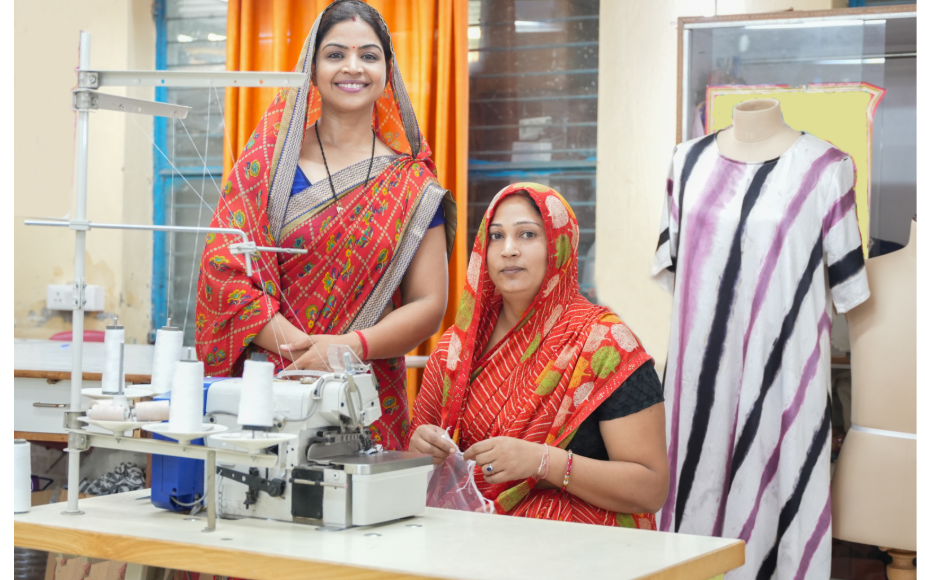
Second, there is a motherhood penalty as well. The garment industry is the highest retainer of female employees in the manufacturing sector in India. While nominally registered as an organized sector industry, the labour force is informalized with no labour contracts, low wages, poor working conditions and no access to social security benefits. Most industry employers hire young girls before they reach their peak fertility phase and lay off once they enter childbearing age.
This acts as a dampener on skilling because one cannot apply one’s skills for too long in the labour market. The garment manufacturing industry is only interested in hiring adolescent to young adult girls. Consequently, training programmes are also designed for this age group. But what about women who are past the childbearing age and who want to re-enter the labour force? There is, unfortunately, a lack of skilling and re-skilling opportunities for such women. Even when women are not laid off once their first child is born, covert behaviour on the part of employers such as making them work in terrible work conditions with no opportunity to recover from childbirth or lack of childcare provisions; denying upskilling or promotions eventually leads to women having to leave such work.
Gender disparities in the garment sector are attributed to both direct discrimination and structural barriers — occupational segregation, lack of union representation, and limited access to training and promotion. Ironically, evidence suggests this is because of perceived social norms rather than reality: a study of India's largest garment manufacturer found female supervisors took 33% less unauthorised leave and had roughly half the attrition rate of male supervisors, yet men continued to be preferentially chosen for supervisory roles on the assumption they were better suited to it.
Third, women are segregated in traditional “feminine” sectors such as jewellery making, embroidery, sewing and tailoring, interior designing, cosmetology etc. Their chances of taking up traditionally male jobs such as car mechanics, mobile phone repairing, plumbers, electricians are very slim due to safety and security concerns.
The care burden is a significant social norm barrier for women both in skilling and labour force participation. According to MoSPI (Ministry of Statistics and Programme Implementation, GoI), women in India perform 8 times more care work than men. So much of their time is gone in performing care duties that unless skilling programmes are designed in a flexible manner, it is impossible for women to devote continuous 6-8 hours in a day to any training programme. Alarmingly, 51.9% of women in the 15-29 age band are neither in education, employment or training (NEET) in the country. The main reason cited for this is high burden of care work.
While the government is trying new methods to work around some of these social norms like building a dedicated training centre in each district; dedicated women’s hostel for residential training purposes; funds transfer for transportation from home to training centre and back, etc.; there are some critical issues which are still overlooked. For example, large scale public campaigns need to be implemented to raise awareness among parents and communities and break social norms that restrict women from accessing and owning mobile phones for work and business purposes. And crucially, the garment manufacturing sector employers need to be gender sensitized to provide safe work environments for women; the government must improve roadways and transportation so that commutes are safe and affordable; and finally invest in the burgeoning MSME sector as estimates suggest that women entrepreneurs have the potential of generating 150-170 million new jobs if they are provided adequate digital literacy and financial management skilling.

 via feedly