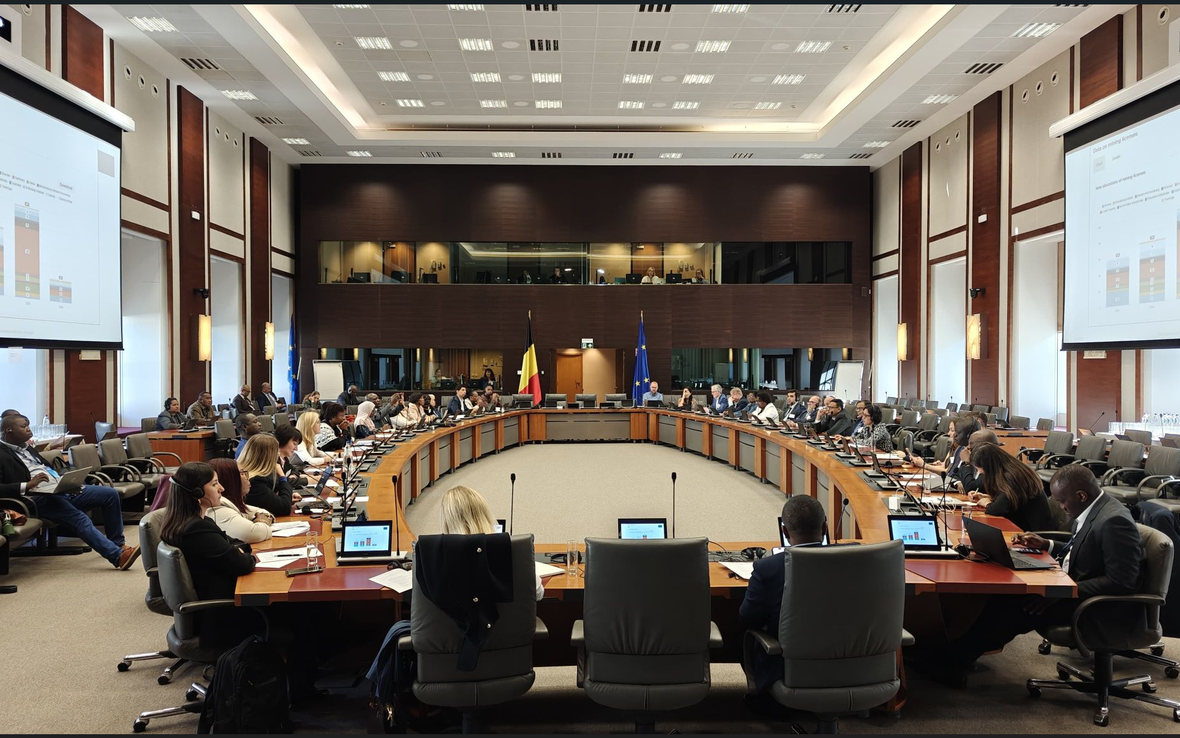
At the EITI Global Conference, Oxfam called for the transparency commitments built over two decades to be enforced in today’s resource deals.
This blog is the final in a series discussing EITI Standard implementation ahead of its Global Conference. Read the previous blogs on Pax Silica in the Philippines, gender equality, and Zambia’s copper rush.
More than twenty years ago, when my Oxfam colleagues were building our natural resource justice work, they frequently pointed to Equatorial Guinea as an example of how natural resources can turn from a blessing to a curse. There, oil wealth enriched a ruling elite while millions of people lacked basic services. As people starved, President Obiang and his family made increasingly outlandish purchases, including a $30 million Malibu mansion, a private jet, and even Michael Jackson's famed crystal-covered glove.
Speaking on a panel at this year’s Extractive Industries Transparency Initiative (EITI) Global Conference in Brussels, I raised an uncomfortable comparison. Today, the president of the United States is engaged in a similar pattern of pursuing resource deals around the world that create opportunities for his family and politically connected investors at the expense of the people who own the resources.
The New York Times’ recent reporting on Kazakhstan shows where this is already happening. There, President Trump and Commerce Secretary Howard Lutnick cut a billion-dollar tungsten mining deal that will enrich their children. As the Times Reports, “Their sons were soon doing business with partners in a deal that their fathers were negotiating, continuing a pattern of self-enrichment in the second Trump administration that has few precedents in American History.”
The difference between now and twenty years ago is that we have spent the intervening decades building a culture of transparency and mechanisms for disclosure. Institutions like EITI have helped establish that citizens have a right to know who profits from their natural resources.
Transparency gives countries bargaining power
NRGI President and CEO Suneeta Kaimal made a similar appeal in her conference remarks. She described EITI as a “sleeping giant”: its standards already appear in international frameworks shaping the global competition for resources, but their influence depends on whether governments, companies, and civil society insist on their implementation.
For countries negotiating with powerful partners, those commitments provide bargaining power. They establish expectations against which proposed deals can be judged, and give citizens grounds to challenge arrangements made without their knowledge or consent.
Zambia's recent experience dealing with the United States illustrates this. Recently, the Trump administration offered Zambia health assistance (which it previously provided through USAID) in exchange for preferential access to the country's minerals. Zambia resisted, and on October 8 announced that the health agreement had been separated from the minerals negotiations.
The minerals negotiations still need scrutiny. But Zambia’s pushback shows why the institutions and expectations built over decades matter: they help make an unequal bargain contestable. Health funding should not depend on surrendering access to public resources, and citizens should be able to examine the terms their government is negotiating.
Close the implementation gap
We have a strong EITI Standard. But far too often, governments and companies enjoy the credibility of association with EITI without fully implementing its requirements or honoring their commitments. The gap between those promises and actual disclosure weakens the bargaining power that transparency should provide.
In our 2023 report, Unfinished Business, NRGI’s Rob Pitman and I found that 37 of the 57 EITI-implementing countries disclosed contracts only partially or not at all. Amendments and annexes were frequently missing, leaving citizens unable to examine the full terms governing their resources. Despite the disclosure requirement, implementation lags behind. Unfortunately, there has been minimal progress made on disclosing contracts since the last EITI Global Conference in Senegal in 2023, and similar implementation gaps exist across the EITI Standard, from disclosing beneficial owners to GHG emissions to promoting women's participation.
Companies must also be held accountable. ExxonMobil remains represented on the EITI Board, even while failing to disclose its project-level payments to governments in all countries of operation. Exxon will also not meet the EITI's requirements on contract or commodity trading transparency.
EITI’s credibility depends on what it does about these gaps. Governments and companies must deliver the disclosures they have committed to making, and EITI must verify compliance and act when those commitments remain unfulfilled.
Put those commitments to work in the DRC
The Democratic Republic of Congo (DRC) offers an immediate opportunity for EITI to act. DRC’s government recently announced a Strategic Partnership Agreement with the United States that gives American investors preferential access to mineral assets alongside broadly worded commitments on peace and security.
The overarching agreement is public. Important decisions about its implementation remain difficult to scrutinize, however. The Strategic Asset Reserve, the list of mineral assets offered to potential investors, has not been published. Nor is there a comprehensive public inventory connecting those assets to subsequent awards, transactions, companies, and contracts.
Congolese citizens need that information to assess what their country is offering, what it will receive in return, and who stands to benefit.
Oxfam and allies have submitted a shadow report for the DRC’s upcoming EITI Validation, the assessment of its implementation of the Standard. We are calling upon EITI to examine how assets are selected, how investors obtain rights, which agreements govern those rights, and who ultimately owns the companies involved, including in transactions involving state-owned enterprises.
These questions fall within established EITI requirements. Governments should not be able to avoid scrutiny by packaging decisions about mineral rights as partnerships, memoranda of understanding, or other arrangements. Any agreement that defines the terms for extracting oil, gas, or minerals must be disclosed.
Where required information remains unpublished, EITI must identify the gaps, reflect them in its assessment, and require corrective action. Membership must mean more than a general commitment to transparency.
Accountability needs people who can speak freely
Publishing agreements makes scrutiny possible, but that's worth little if people aren't free to question them. With mining among the deadliest sectors for land and environmental defenders, protecting those freedoms can be a matter of life and death.
At the conference, the Resource Justice Network led a joint civil society communiqué calling on EITI to make protecting civic space a core priority. It highlighted a gap in EITI’s approach: governments can oftentimes maintain their clout as an EITI-implementing country even as they close civic space.
The communiqué called for stronger enforcement of EITI’s civil society requirements, including where intimidation and self-censorship affect debate on extractive governance. It also urged governments, companies, and supporting countries to take responsibility for protecting civic space.
That is the work ahead after Brussels. Zambia’s resistance shows that unequal demands can be challenged. The DRC’s Validation provides an opportunity to insist that existing rules apply to the new generation of resource deals. EITI has the standards, the institutions, and decades of experience to support that effort. It is time to wake the sleeping giant.



 via feedly